


Suppose
 R
R R
R and
and
 R
R R
R are linear maps. Then it makes sense to consider
the composition
are linear maps. Then it makes sense to consider
the composition  given by
 x
x x
x . Notice it's
  that is applied first. In
terms of the matrices, if
that is applied first. In
terms of the matrices, if  and
and  , then
x
, then
x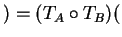 x
x x
x x
x x
x . Thus
composition of linear maps corresponds to matrix multiplication.
The order of the matrices is the same as the order of the maps
when written as a composition.
. Thus
composition of linear maps corresponds to matrix multiplication.
The order of the matrices is the same as the order of the maps
when written as a composition.
This explains in particular why matrix
multiplication is associative, i.e., why
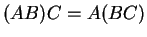 :
Composition is obviously associative, since
:
Composition is obviously associative, since
 and
and
 applied to
x are
both just
applied to
x are
both just
 x
x .
.