


Here are some comments/suggestions on Assignment #2.
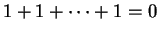
p. 5, Ex. 8: As mentioned on p. 3, a field  is said
to have characteristic 0 if in you never get
is said
to have characteristic 0 if in you never get
 .
.
In this problem, a ``copy'' of the rationals is a subfield that is isomorphic to the field of rationals. Here ``isomorphic'' means isomorphic as fields rather than as vector spaces--there is a one-to-one correspondence that preserves plus, unary minus, multiplication, 0, and 1.
It is up to you to say what the correspondence is. You could
start like this: ``Given a field of characteristic 0,
define
 by
by  ,
,  , ...
You'll need to say what
, ...
You'll need to say what  is on positive integers, negative
integers, and fractions.
is on positive integers, negative
integers, and fractions.
In addition to defining , there are several issues to
think about--give the best explanation you can.
First, why is one-to-one? For example, why can't
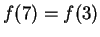 ?
?
Second, is ''well defined``? In other words, if you say
what
 should be and what
 should be,
are these two values the same? (They had better be.)
should be,
are these two values the same? (They had better be.)
Third, why does preserve the field operations? (Don't
go into too much detail on this.)
p. 48, Ex's. 2, 3: Try the method in the on-line notes for 1-F.
p. 48, Ex. 7: For a basis, think about what you get when you set one letter to 1 and the others to 0. The dimension of a vector space means the number of vectors in a basis. (We'll be discussing dimension more soon.)
p. l49, Ex. 9: These letters are alpha, beta, gamma. For a method, see comments below on E-1.
E-1: For linear independence, use an implication: Suppose
that there is a linear relation
 . Does
this imply that
. Does
this imply that  are all 0?
E-2: Notice the coefficients are in the 2-element field
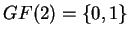 .
.
E-3: For (a), row-reduce and take the nonzero rows of the matrix in row-reduced form--we'll be discussing why this works. For (b), see the on-line notes for 1-F. For (c), take the general solution to the homogeneous equations with this matrix of coefficients and write it in vector form.
E-8: (b) asks you to explain why if you know the linear relations between columns in a matrix that is in row-reduced echelon form, you can determine the entries of the matrix. Notice that linear relations can be used to say how one column is or is not a linear combination of other columns.
For (c), your answer can be short, just quoting (b).