


For any integer  we can make the ``integers modulo
  '',
which I call
'',
which I call
 . The elements of
are
. The elements of
are
 . For example,
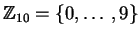 .
.
has operations of  ,
,  , and
, and  , which I'll
explain below. These operations have the properties you have
come to expect--all the field properties except the existence
of multiplicative inverses.
, which I'll
explain below. These operations have the properties you have
come to expect--all the field properties except the existence
of multiplicative inverses.
However, if is prime, then you do get multiplicative
inverses. So there is a finite field of each prime size  ,
namely
,
namely
 . In other words,
 ,
,
 ,
,
 , etc.,
are fields.
, etc.,
are fields.
A more general fact is that there is one finite field of each
prime-power size, called the Galois field of that size, or
GF . So
GF
. So
GF .
.
Focus on one integer .
To understand , and in
, it's helpful first
to get used to ``congruences modulo ''. ( is called
the modulus.) We say that two integers
 are congruent modulo if divides their
difference
are congruent modulo if divides their
difference  . In other words, they are a multiple of
apart. In that case we write
. In other words, they are a multiple of
apart. In that case we write
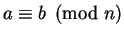 . For
example, if we have chosen
. For
example, if we have chosen  , then
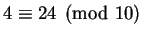 and also
 . Congruences are important
because when you stick to one modulus, congruences have nice
compatibility with , , and (which we won't go
into now).
. Congruences are important
because when you stick to one modulus, congruences have nice
compatibility with , , and (which we won't go
into now).
For addition, subtraction, and multiplication in
,
do the operation in
 first. If the answer is
outside the range
first. If the answer is
outside the range
 , replace the answer by the
integer in that range that is congruent to the answer modulo
.
, replace the answer by the
integer in that range that is congruent to the answer modulo
.
So in
 ,
,  ,
,  , and
, and
 .
In the case , for and , this is the same as
writing out an addition or multiplication and then erasing
all digits of the answer except the last one. (If you are
familiar with number bases, for other values of , working in
.
In the case , for and , this is the same as
writing out an addition or multiplication and then erasing
all digits of the answer except the last one. (If you are
familiar with number bases, for other values of , working in
 is the same as working with last digits in base .)
You will find that
is not a field: If you look for
multiplicative inverses, you will find that only the elements
 have them (the elements with no factor of 2 or 5).
 is also not a field, but the operations of addition
and subtraction are the familiar ``clock arithmetic'', as
when you ask what time is 7 hours ahead of 6:00. (But
instead of 12 we should write 0, to be within the
range
is also not a field, but the operations of addition
and subtraction are the familiar ``clock arithmetic'', as
when you ask what time is 7 hours ahead of 6:00. (But
instead of 12 we should write 0, to be within the
range
 .)
.)
 is a field, since
  is prime. For example,
the multiplicative inverse of 5 is 9, since
is prime. For example,
the multiplicative inverse of 5 is 9, since
 .
.
Your homework problem about  is really talking
about
. Here all the even integers are congruent
to each other modulo 2, and all the odd integers are
congruent to each other modulo 2.
is really talking
about
. Here all the even integers are congruent
to each other modulo 2, and all the odd integers are
congruent to each other modulo 2.