


Here is the observation we have been using in class:
Observation 1. For an
 matrix
  whose columns
are column vectors
whose columns
are column vectors
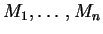 , and for
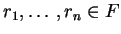 , the following are equivalent:
(1)
r 0, i.e.,
r is in the null space of .
0, i.e.,
r is in the null space of .
(2)
 0, i.e.,
 are coefficients
for a linear relation of the columns of .
are coefficients
for a linear relation of the columns of .
(3)
are solutions of the set of homogeneous linear
equations whose matrix of coefficients is
The reason is simply that
 r.
r.
For example,
![$ r_1 \left[\begin{array}{r}1\ 2\end{array}\right] + r_2 \left[\begin{array}{r...
...{array}\right] \left[\begin{array}{r}r_1\ r_2\ r_3\ r_4\end{array}\right]$](img9.gif) .
.
From this we get:
Observation 2. The linear relations between columns of a matrix remain unchanged when you do row reduction.
The reason is that elementary row operations do not change the solutions to the set of homogeneous linear equations whose coefficient matrix is the matrix in question. According to Observation 1, these solutions give the coefficients for linear relations.
We also get a method:
Observation 3. Given a spanning set for a subspace of a vector space, to thin it out to a basis of the subspace, do this:
Step 1. Make a matrix with the spanning set as its columns.
Step 2. Row-reduce to a matrix  in row-reduced echelon form.
Step 3. Look for the pivot columns of .
Step 4. Choose the corresponding columns of the original matrix
to be the basis. For example, if the pivot columns in
are 1 and 4, then use columns 1 and 4 of .
Why this works:
The pivot columns of are clearly linearly independent,
since each has an entry with value 1 where the others have value
0, and the other columns are linear combinations of the pivot
columns. Since has the same linear relations between
columns as (by Observation 2), the same statement is true
about the corresponding columns of .
Example: Find a basis for the subspace of
 spanned
by
spanned
by  ,
,  ,
,  , and
, and  .
.
Solution. Make the matrix
![$ M = \left[\begin{array}{rrrr}1&3&5&7\\ 2&4&6&8\end{array}\right]$](img16.gif) and
row-reduce, getting
and
row-reduce, getting
![$ \left[\begin{array}{rrrr}1&0&-1&-2\\ 0&1&2&3\end{array}\right]$](img17.gif) . The first
two columns are the pivot columns, so the first two vectors in the
original list are a basis for the span of all four.
. The first
two columns are the pivot columns, so the first two vectors in the
original list are a basis for the span of all four.