


 is the set of integers (positive, negative, and 0).
To mathematicians, ``integers'' and ``whole numbers'' mean
the same thing. (Sometimes in K-12 math people say ``whole
numbers'' to mean just integers  .)
.)
 is the set of rational numbers, such as
  ,
,  ,
,  , and
, and  .
.
 is the set of real numbers, which includes the rational
numbers and also other numbers such as
is the set of real numbers, which includes the rational
numbers and also other numbers such as  ,
,  , and
, and  .
.
 is the set of complex numbers
  ,
,  .
We'll look at complex numbers more closely later.
.
We'll look at complex numbers more closely later.
 means a function that assigns to each
  some
value
some
value
 . Notice that this means
  is defined
for all . When specifying a function such as
is defined
for all . When specifying a function such as
 we should write ``define
 ''
by
''
by
 ``, since
 would not be correct.
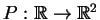
In calculus, we talk about a function  of two variables,
or a vector-valued function
of two variables,
or a vector-valued function  of one variable, etc.
But using functions on sets we can describe these all in the
same general way:
of one variable, etc.
But using functions on sets we can describe these all in the
same general way:
 ,
,
 .
.
Notation: We're using
 for
the vector space of continuous functions from
to
.
for
the vector space of continuous functions from
to
.
To repeat the proof given in class:
Theorem.
 .
.
Proof. Suppose not; in other words, suppose
 .
Then we can write
.
Then we can write
 , in lowest terms,
where
, in lowest terms,
where
 . Squaring we get
 ,
so
,
so
 . Then
  is even, so
  is even
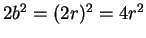
and we can write
is even
and we can write  for some
 . In other
words,
. In other
words,
 , so
, so
 . Then
 is even, so
  is even. But since both and
are even,
is even. But since both and
are even,  is not a fraction in lowest terms,
which is a contradiction.
is not a fraction in lowest terms,
which is a contradiction.
Therefore we were incorrect in supposing
,
and the theorem is proved. 
Notice that saying is even is the same as saying that 2
divides .
In doing the homework, which asks for a generalization to any
prime  in place of
  , it might be helpful to try
  privately first. Then write the same thing for a prime in
general and hand it in.
privately first. Then write the same thing for a prime in
general and hand it in.
By way of background, you can use the fact that every integer
 is a product of primes, and in only one way.
Your proof doesn't have to be phrased like mine; you can even use implication arrows as long as it's clear. But you do need to start by saying you are supposing the opposite and you do need to mention near the end that there is a contradiction.
The box is optional; it's a way of saying that's the end
of the proof, so anyone reading the proof doesn't get confused and
keep reading. An older way is to say ''Q.E.D.`` (initials in
Latin for ''which was to be proved``).