


Quiz 8 in discussion section Tuesday, November 20:
There will be no Quiz 8, since it would be the day after the midterm.
Assignment due nominally in lecture on Wednesday, November 21 but you can hand it in a week late on Wednesday, November 28. However, please look at the material earlier or you will have more and more trouble following the lectures and also it will get in the way of Assignment #9.
| where | Do but don't hand in | Hand in |
| U | U-2, U-3, U-4, U-5 | U-8, U-10, U-12, U-15 |
| U-6, U-9, U-12 | ||
| V | V-19, V-20 | V-16, V-17, V-18 |
| Z | Z-1 | Z-2 |
Problem
Z-1. As mentioned in Problem Q-1(g), the negation of ``for all  ,
the property
,
the property  holds'' is ``there exists for which
  doesn't hold'' (where is some statement mentioning ).
In other words, if we write
doesn't hold'' (where is some statement mentioning ).
In other words, if we write  for ``not'',
 is the same as
 . Notice that the ``not'' is moved inside and ``for all'' becomes
``there exists'' Similarly,
. Notice that the ``not'' is moved inside and ``for all'' becomes
``there exists'' Similarly,
 is the same as
 .
.
The set
 of real numbers has the property that between
any two numbers there is another one. In other words,
has the property
of real numbers has the property that between
any two numbers there is another one. In other words,
has the property
 and
and  .
.
The set
 of integers does not have this property. Write down
a logical statement that says what holds for
, putting ``not''
as far inside as possible.
of integers does not have this property. Write down
a logical statement that says what holds for
, putting ``not''
as far inside as possible.
Notes.
(1) ``not (P and Q)'' is the same as ``(not P) or (not Q)''.
(2) It's a little informal to put `` '' in with the quantifiers,
as in ``
'' in with the quantifiers,
as in ``
 '', but it's often done and is easier
for our purposes. In doing a negation, the ``'' doesn't change.
'', but it's often done and is easier
for our purposes. In doing a negation, the ``'' doesn't change.
Problem
Z-2. To do definitions and proofs in calculus is actually harder than
for linear algebra, partly because their logical statements are
more complicated, going back and forth between ``for all'' and ``there
exists''. For example, `` is a continuous function'' is expressed
by the statement,
is a continuous function'' is expressed
by the statement,
``for all and for all
 , no matter how small,
there is a
, no matter how small,
there is a
 small enough so that for all
  , if
, if
 then
then
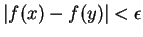 ''.
''.
In shorter notation, without the explanatory part about big and small, this says
 .
.
If is not continuous, what logical statement holds? Put
``not'' as far inside as possible. (The negative of
 is but not
  , i.e.,
and
, i.e.,
and  .)
.)
Notes.
(1) In logic, the symbols  and
and  are called
``quantifiers''.
are called
``quantifiers''.
(2) Going back and forth between and is
called ``alternation of quantifiers''.