


Quiz 7 in discussion section Tuesday, November 13:
Just be able to write down correctly the last example from lecture notes on 6-M showing how a linear transformation derived from a square matrix can have a simpler matrix with respect to a basis different from the standard basis, applied at both ends.
Specifically, we looked at the linear transformation
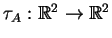 with
with
![$ A = \left[\begin{array}{cc}3&2\\ 2&3\end{array}\right]$](img2.gif) and found that its
matrix with respect to the basis
and found that its
matrix with respect to the basis
![$ \left[\begin{array}{c}1\\ 1\end{array}\right], \left[\begin{array}{c}1\\ -1\end{array}\right]$](img3.gif) (at both ends) is diagonal.
(at both ends) is diagonal.
There will be different numbers instead of 3,2,2,3 but the basis will be the same. You will not be asked to mention or derive eigenvalues, even though this problem does illustrate them.
Assignment due nominally in lecture on Wednesday, November 14 but you can hand it in Friday, November 16.
| where | Do but don't hand in | Hand in |
| p. 95 | Ex. 3, 5 | Ex. 2 |
| V | V-4, V-5, V-6, V-9 | V-7, V-13, V-14 |
| V10, V-11, V-12 | V-15, V-16 | |
| W | W-1, W-2, W-3, W-4 |
Problem
W-1. Count the number of invertible
 matrices over
GF(q). What is this number for
matrices over
GF(q). What is this number for  ?
?
Method: The rows should be a basis. For the first row any nonzero triple will do. The second row should not be in the span of the first row. The third row should not be in the span of the first two rows. How many choices at each step?
Problem
W-2. For matrices over
 or
or
 , it is possible to
add up infinite series. Questions of convergence are similar
to Math 33B, but we'll look only at examples that do converge.
, it is possible to
add up infinite series. Questions of convergence are similar
to Math 33B, but we'll look only at examples that do converge.
(a) Find  for
for
![$ D = \left[\begin{array}{cc}1&0\\ 0&-1\end{array}\right]$](img9.gif) .
.
(Method: Take the usual series for  and put
  .
As you did for polynomials applied to matrices, the term 1
becomes
.
As you did for polynomials applied to matrices, the term 1
becomes  . Add up entries and simplify.)
(b) Find  for
for
![$ J = \left[\begin{array}{cc}0&-1\\ 1&0\end{array}\right]$](img14.gif) .
.
Here  is an unspecified scalar and
  is the
the same as a
is the
the same as a
 rotation and also the same as
the matrix used to represent
rotation and also the same as
the matrix used to represent
 in Problem G-6.
You will need to compute the powers of to see the pattern;
then express each entry of as a power series and
see if it is familiar.
in Problem G-6.
You will need to compute the powers of to see the pattern;
then express each entry of as a power series and
see if it is familiar.
(c) Find
 (simplifying if possible),
where
(simplifying if possible),
where  is as in Problem V-5.
Problem
W-3. Let  be the subspace of
 that is the solution
space of
that is the solution
space of
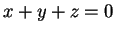 . Recall that early in the course we used
as an example of vector space that has no ``best'' basis.
. Recall that early in the course we used
as an example of vector space that has no ``best'' basis.
The transformation  on
given by
on
given by
![$ P =
\small\left[\begin{array}{ccc}0&0&1\\ 1&0&0\\ 0&1&0\end{array}\right]$](img25.gif) takes to itself, so if
takes to itself, so if
 is the ``restriction'' of to then
 is a linear transformation on to itself. Notice
that is really a rotation on by
is a linear transformation on to itself. Notice
that is really a rotation on by
 .
.
What is the matrix of with respect to the basis
 of (used at each end of the transformation) if
(a)
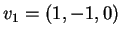 and
and
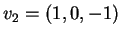 ?
?
(b)
and
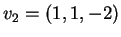 ?
?
Problem
W-4. We have discussed the fact that one basis of a vector
space can always be mapped to another basis of using
a linear transformation1. In the case  , such a
transformation will be
, such a
transformation will be  for some matrix
  .
One easy case you know how to do is where the first basis is the
standard basis and the second is possibly ``nonstandard'':
Then the columns of are the nonstandard basis.
.
One easy case you know how to do is where the first basis is the
standard basis and the second is possibly ``nonstandard'':
Then the columns of are the nonstandard basis.
(a) Working with
 , find so that
takes the nonstandard basis
, find so that
takes the nonstandard basis
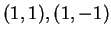 to the standard basis
 .
.
(Method: First solve the problem in the other direction, then
invert. Remember that you need to rewrite the basis vectors
as columns. Check your answer by seeing if does
what it is supposed to.)
(b) Again working with
, find so that
takes the nonstandard basis
to the nonstandard
basis
 .
.
(Method: First solve the problem of taking the standard basis
to the first nonstandard basis
, getting a matrix
 . Then solve the problem of taking the standard basis to
the second nonstandard basis given, getting a matrix
. Then solve the problem of taking the standard basis to
the second nonstandard basis given, getting a matrix  .
Finally, let
.
Finally, let
 , since
 takes the first basis to the standard basis
and then to the second basis.)
takes the first basis to the standard basis
and then to the second basis.)