


p. 73, Ex. 4.
Yes, there is such a linear transformation: The
two vectors
 and
and
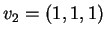 are
not scalar multiples of each other and so are linearly
independent. Therefore they can be extended to a basis
are
not scalar multiples of each other and so are linearly
independent. Therefore they can be extended to a basis
 of
of
 . By Theorem 1, given any
three vectors
. By Theorem 1, given any
three vectors
 in a second vector
space, which can be
in a second vector
space, which can be
 , there is a linear transformation
taking
, there is a linear transformation
taking
 for each
  . We can choose
 ,
,
 and
and  anything we want, say
  .
.
In this problem we were not actually asked to find the transformation.
p. 73, ex. 5.
Notice that
 .
Since a linear transformation preserves linear relations, if
such a
.
Since a linear transformation preserves linear relations, if
such a  exists then we should have
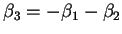 also. But instead,
 . Therefore such a linear transformation
does not exist.
. Therefore such a linear transformation
does not exist.
p. 73, Ex. 6.
By
 the authors mean our standard basis vector
 . We know
 for
for
![$ A =
\left[\begin{array}{cc}a&c\\ b&d\end{array}\right]$](img20.gif) . To display the answer in a form like
Example 1, calculate
. To display the answer in a form like
Example 1, calculate
![$ \left[\begin{array}{cc}a&c\\ b&d\end{array}\right] \left[\begin{array}{c}x\\ y\end{array}\right] =
\left[\begin{array}{cc}ax+cy\\ bx+dy\end{array}\right]$](img21.gif) , which says
, which says
 .
.
p. 73, Ex. 8.
This is a transformation on
 , so
we can use
, so
we can use  where
where  is a
is a
 matrix.
The range of is the column space of , so take
to have columns
matrix.
The range of is the column space of , so take
to have columns
![$ \left[\begin{array}{r}1\\ 0\\ -1\end{array}\right]$](img27.gif) and
and
![$ \left[\begin{array}{c}1\\ 2\\ 2\end{array}\right]$](img28.gif) .
For the third column of we can take any vector already in
the span of those two columns, say
.
For the third column of we can take any vector already in
the span of those two columns, say
![$ \left[\begin{array}{c}0\\ 0\\ 0\end{array}\right]$](img29.gif) . So we
can choose
. So we
can choose
![$ A = \left[\begin{array}{rrr}1&1&0\\ 0&2&0\\ -1&2&0\end{array}\right]$](img30.gif) .
.
For Problem O-1:
Advice: First write down some examples of functions
 . You will see that you need a list of
three numbers for each, so each function corresponds to a
triple. Furthermore, functions add pointwise and triples
coordinatewise, so that vector addition is compatible with the
correspondence, and similarly for multiplication by scalars.
That gives the following idea.
. You will see that you need a list of
three numbers for each, so each function corresponds to a
triple. Furthermore, functions add pointwise and triples
coordinatewise, so that vector addition is compatible with the
correspondence, and similarly for multiplication by scalars.
That gives the following idea.
Given
 , define
 . Then
 Functions
 is one-to-one and onto. Also,
  is a linear
transformation, because the pointwise operations on functions
correspond to the coordinatewise operations on
is a linear
transformation, because the pointwise operations on functions
correspond to the coordinatewise operations on  -tuples.
The importance of this problem is the perspective that it gives:
Our first examples of vector spaces included some consisting of
-tuples and some consisting of functions. Now it is
becoming apparent that even the -tuples were really made of
functions in disguise. How about examples such as
Mat ? This could be viewed as
Functions
? This could be viewed as
Functions , where
 is the set
 of
pairs of indices, or more simply,
of
pairs of indices, or more simply,
 .
.
For Problem O-2:
(b) Just make sure that both of  and
and  are on
the same line. One of them could be the zero vector.
are on
the same line. One of them could be the zero vector.
A shear is a transformation that moves points parallel to some
line. The line is the  -axis in the case of this program.
For Problem O-3:
(a) Yes: For closure under addition,, suppose
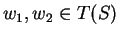 . We must show that
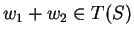 .
To say
.
To say
 is the same as saying that
 for some
 (
( ). Since
is a subspace,
). Since
is a subspace,
 , and since
preserves addition,
, and since
preserves addition,  contains
 . For closure
under multiplication by scalars ...[continue with similar
proof].
. For closure
under multiplication by scalars ...[continue with similar
proof].
(b) Yes: For closure under addition, suppose
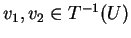 , which is the same as saying that
 . We must show that
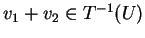 ,
which is the same as saying that
,
which is the same as saying that
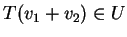 .
Since is linear,
.
Since is linear,
 ,
which is in
,
which is in  because is closed under addition.
Therefore
as required. For
closure under multiplication by scalars ...[continue with
similar proof].
because is closed under addition.
Therefore
as required. For
closure under multiplication by scalars ...[continue with
similar proof].
For Problem O-4:
(ii) is false, while (i), (iii), (iv) are true. (iv) is proved in the handout.
For (i):
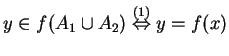 for
some
for
some
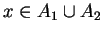
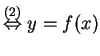 for some with
 or
or

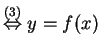 for some
or some
for some
or some
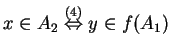 or
or
 , where the
reasons for the double implications are (1) definition of
, where the
reasons for the double implications are (1) definition of
 subset
 , (2) definition of
  , (3) the way ``for
some'' (really
, (3) the way ``for
some'' (really  ) interacts with ``or'', (4) definition of
subset, (5) definition of . Therefore
) interacts with ``or'', (4) definition of
subset, (5) definition of . Therefore
 ,
,
For (ii):
The clearest kind of example is one where
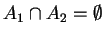 but
but
 is not empty. For
instance let
is not empty. For
instance let
 , let
, let  , define
 by
by
 , let
, let
 ,
and let
,
and let
 . Then
 but
but
 .
.
For (iii):
 or
or 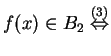
 or
or  ,
,
where the reasons for the double implications are (1) definition
of  , (2) definition of , (3) definition of ,
(4) definition of . Therefore
, (2) definition of , (3) definition of ,
(4) definition of . Therefore
 .
.