


This concerns square matrices and also transformations
 where
where  and
and  have the same finite dimension.
Theorem. Let  be an
be an
 matrix with entries
in a field
matrix with entries
in a field  , with the corresponding matrix transformation
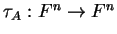 . Also let
be a
linear transformation between vector spaces over , both
of dimension
. Also let
be a
linear transformation between vector spaces over , both
of dimension  , such that
  has matrix with
respect to particular bases of and . The following
conditions are equivalent.
has matrix with
respect to particular bases of and . The following
conditions are equivalent.
 .
.
row-reduces to the
identity matrix.
has rank (``full rank'', meaning the maximum rank possible).
are linearly independent.
are linearly independent.
has a
unique solution.
has a
unique solution.
has a right inverse, i.e., there is an
matrix
 with
with  .
.
has a left inverse, i.e., there is an
matrix
with  .
.
has a two-sided inverse  .
.
has nullity 0; in other words,
nullspace 0
0 .
.
 0
0 0
0
, i.e., there is no  with
with
 .
.
 is one-to-one.
is onto.
is an isomorphism of  with itself
(an ``automorphism'' of )
with itself
(an ``automorphism'' of )
 0.
0.
is one-to-one.
is onto.
is an isomorphism.
with respect to any bases of and
is nonsingular.
Definition. When any (and so all) of these conditions is
satisfied, then is said to be nonsingular. Otherwise A
is singular.
(``Singular'' means ``special'' or ``unusual'', not to be confused with ``single''. So a system of linear equations with nonsingular coefficient matrix has a single solution.)