


The distribution of scores will be accessible on the web. Even if you got a low score this time, as you get a better idea of what is expected in writing down reasoning you should be able to do much better on the second midterm and final. Anyone who gets a solid grade on the final and has done the homework can get a good grade in the course. Most people are doing OK on quizzes and homework, so they should be able to learn to do well on exams.
Although letter grades are not recorded for exams, a rough idea of the grade equivalent of scores would be A-/A 40-50, B- to B+ 30-39, C- to C+ 20-29. This means the average grade was low this time, but as people get better at writing the ``proofs to know'' the average grade should become much higher by the end of the course.
In terms of writing down a proof, it is expected that the answer
should mention the key points of the proof in the correct
relationship, e.g., not having implications in the wrong direction.
It is also expected that there should not be nonsense, e.g., ``Each
vector is linearly independent'', ``the vector space has  vectors'',
 , etc.
1. (a) We know
 Pols
Pols with
with
 , so we can move the problem over to
 , where the question becomes whether the vectors
 ,
,  ,
,
 are linearly
independent. Make
are linearly
independent. Make  with these as its rows.
![$ M \rightsquigarrow \dots
\rightsquigarrow \left[\begin{array}{rrr}1&0&-\frac 32\\ 0&1&2\\ 0&0&0\end{array}\right]$](img11.gif) , so has rank 2
and the vectors are linearly dependent. Therefore the original
polynomials are linearly dependent.
, so has rank 2
and the vectors are linearly dependent. Therefore the original
polynomials are linearly dependent.
(b) For convenience, let's write this as
 .
.
Method #1: Just notice
 ,
which gives a linear relation
,
which gives a linear relation
 .
Shifting over one position we also get
.
Shifting over one position we also get
 . The coefficients involved
in these two relations are
. The coefficients involved
in these two relations are
 and
and
 ,
not proportional.
,
not proportional.
Method #2: Use
 Mats
Mats by
by
![$ \left[\begin{array}{r}a\\ b\\ c\\ d\end{array}\right]\rightarrow
\left[\begin{array}{rr}a&b\\ c&d\end{array}\right]$](img20.gif) , so we need to find the linear relations between
columns of
, so we need to find the linear relations between
columns of
![$ M = \left[\begin{array}{rrrrr}1&3&5&7\\ 2&4&6&8\\ 3&5&7&9\\ 4&6&8&10\end{array}\right]$](img21.gif) ,
which are given by the null space of .
,
which are given by the null space of .
Row reducing,
![$ M \rightsquigarrow \dots \rightsquigarrow E = \left[\begin{array}{rrrr}1&0&-1&-2\\ 0&1&2&3\\ 0&0&0&0\\ 0&0&0&0\end{array}\right]$](img22.gif) .
The general solution to
.
The general solution to
![$ E \left[\begin{array}{r}r\\ s\\ t\\ u\end{array}\right] =$](img23.gif) 0 is
0 is
![$ \left[\begin{array}{r}r\\ s\\ t\\ u\end{array}\right]
= t \left[\begin{arra...
...end{array}\right] + u \left[\begin{array}{c}2\\ -3\\ 0\\ 1\end{array}\right]$](img24.gif) . Therefore two independent
choices of coefficients for the linear relations are
and
. Therefore two independent
choices of coefficients for the linear relations are
and
 .
.
2. To get
 , we simply put together the
two sets of equations and take the solution space. So we want a
basis for the null space of
, we simply put together the
two sets of equations and take the solution space. So we want a
basis for the null space of
![$ M = \left[\begin{array}{ccc}1&1&1\\ 3&2&1\\ -1&1&3\\ 3&1&-1\end{array}\right]$](img27.gif) .
We get
.
We get
![$ M \rightsquigarrow \dots \rightsquigarrow \left[\begin{array}{ccc}1&0&-1\\ 0&1&2\\ 0&0&0\\ 0&0&0\end{array}\right]$](img28.gif) , for
which a basis for the null space is
, for
which a basis for the null space is
![$ \left[\begin{array}{c}1\\ -2\\ 1\end{array}\right]$](img29.gif) .
.
3. (a) We use these facts: (i) If  has a basis of
  elements then
 ; (ii) in
  , any
, any  or more
vectors are linearly dependent.
or more
vectors are linearly dependent.
If has a basis of elements and a basis of elements,
then by (i),
and
 so
so
 .
Suppose
.
Suppose  . Then the standard basis vectors of
  correspond to a list of linearly independent vectors in ,
which contradicts (ii). If
correspond to a list of linearly independent vectors in ,
which contradicts (ii). If  we get a similar contradiction
in which and are switched. So the only possibility is
that
we get a similar contradiction
in which and are switched. So the only possibility is
that  .
.
(b) Suppose
 is a minimal spanning set for .
If they were linearly independent, then some
is a minimal spanning set for .
If they were linearly independent, then some  would be
in the span of the others, so if we were to omit it the span of the
new list would still be all of . But then the original
list was not minimal, a contradiction. Therefore they are linearly dependent.
would be
in the span of the others, so if we were to omit it the span of the
new list would still be all of . But then the original
list was not minimal, a contradiction. Therefore they are linearly dependent.
4. Let  be any matrix with entries in some field, and
suppose
be any matrix with entries in some field, and
suppose  is the row-reduced echelon form of . We know
that row reduction doesn't change linear relations between
columns, so has the same linear relations as . Using
linear relations between columns we can tell whether a given
column is or is not a linear combination of other specified
columns, and if it is, then with what coefficients. The pivot
columns of are those that are not in the span of the
preceding columns; their entries are determined, since they are the
same as some or all of the columns of an indentity matrix, in order.
Each non-pivot column is in the span of the preceding pivot
columns, and its entries consist of the coefficients used; therefore
the entries of the non-pivot columns are determined by the linear
relations. All together, then, the entries of are completely
determined by . In other words, the row-reduced echelon
form of is unique.
is the row-reduced echelon form of . We know
that row reduction doesn't change linear relations between
columns, so has the same linear relations as . Using
linear relations between columns we can tell whether a given
column is or is not a linear combination of other specified
columns, and if it is, then with what coefficients. The pivot
columns of are those that are not in the span of the
preceding columns; their entries are determined, since they are the
same as some or all of the columns of an indentity matrix, in order.
Each non-pivot column is in the span of the preceding pivot
columns, and its entries consist of the coefficients used; therefore
the entries of the non-pivot columns are determined by the linear
relations. All together, then, the entries of are completely
determined by . In other words, the row-reduced echelon
form of is unique.
5. (a) False: and  have the same rank, since
row rank = column rank and rows of are columns of .
have the same rank, since
row rank = column rank and rows of are columns of .
(b) False: if
 GF
GF then in
  with
with  we have
 0.
0.
(c) True: Using the theorem that
dim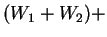 dim
dim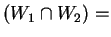 dim
dim dim
dim we have
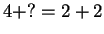 , so the
dim
, so the
dim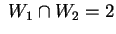 .
.
(d) True: Two vectors are linearly dependent when one is a scalar multiple of the other. Since the only scalars are 0 and 1, if both vectors are nonzero they would have to be equal, which they are not.