


Quiz 5 in discussion section, Tuesday, October 30:
One of these two simple problems: (a) Show that a linear
transformation is uniquely determined by its values on
a basis. (b) For a linear transformation  , show
that
, show
that
 NullSpace
 .
.
Assignment due in lecture Wednesday, October 31 (shorter because of the midterm)
| where | Do but don't hand in | Hand in |
| p. 73 | Ex's 4, 5, 6, 8 | |
| O | O-1, O-2, O-3, O-4 |
(For Ex. 4, see Theorem 1.)
Problem
O-1. Recall that for a set  and field
  ,
Functions
,
Functions is a vector space when
vector-space operations are defined pointwise.
is a vector space when
vector-space operations are defined pointwise.
Show that if
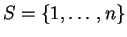 , then
 Functions. (Therefore any finite-dimensional
vector space over a field , being isomorphic to
Functions. (Therefore any finite-dimensional
vector space over a field , being isomorphic to  for
some
for
some  , is isomorphic to a vector space of functions.)
Problem O-2. Log onto a computer and run Netscape or Internet Explorer. You are welcome to use the PIC Lab, BH 2817. If any of the following doesn't work, let me know.
On the class home page, click on ``Linear transformation demo in
Java''. After the page loads, click on ``Linear program''. You
should see the domain and image of a linear transformation on
 . Then click on the button with a house to select
that picture in the domain. You should find that you can drag
the vectors on the right that are images of
. Then click on the button with a house to select
that picture in the domain. You should find that you can drag
the vectors on the right that are images of  and
and
 . The matrix entries shown will change as you do.
Try each of the following and write down the corresponding matrix:
(a) Invent a transformation that distorts the house.
(b) Invent a transformation that takes the whole house into a single line (a singular transformation).
(c) through (i): At the upper right, select different kinds of transformations. For each, if there is any choice in the example, invent an example that is different from the default example. Otherwise, copy down the default example.
Problem
O-3. Let  and
and  be sets and let
 be a
function. (People also say ``map'' or ``mapping''). By the definition
of a function, each element
be a
function. (People also say ``map'' or ``mapping''). By the definition
of a function, each element  has a unique image
 .
.
There is also a simple notation for how  treats subsets:
If
treats subsets:
If  is any subset of , then
  is a shorthand
for the set of all images of elements in ; in symbols,
is a shorthand
for the set of all images of elements in ; in symbols,
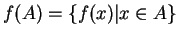 . For example, if
 is given by
 , then
![$ f([0,2]) = [0,4]$](img25.gif) .
.
In the other direction, if  is any subset of , then
 is a shorthand for the set of all elements of
that map into ; in symbols,
is a shorthand for the set of all elements of
that map into ; in symbols,
 . For example, if
is given by
, then
. For example, if
is given by
, then
![$ f^{-1}([0,4]) = [-2,2]$](img29.gif) .
.
For a single element  , people often write
  when they mean
 , but is
definitely a subset since it could have more than one element or
it could be empty. For example, if
is given by
, then
, but is
definitely a subset since it could have more than one element or
it could be empty. For example, if
is given by
, then
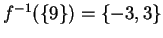 , and
, and
 . But if is a one-to-one
correspondence then
. But if is a one-to-one
correspondence then  is a function.
Let
 be a linear transformation between vector spaces.
(a) If is a subspace of  , is
, is  necessarily
a subspace of
necessarily
a subspace of  ?
?
(b) If  is a subspace of , is
  necessarily
a subspace of ?
necessarily
a subspace of ?
(Give reasoning.)
Problem O-4. Here are four possible rules about mapping subsets. Three are true and one is false. Identify which is false, prove the first two true ones, and find a counterexample for the false one.
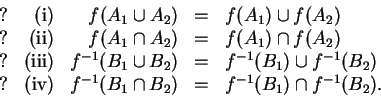
Sample: (iv) is true. To prove it, since both sides are sets we show they are equal by showing they have the same elements:
 and
and 
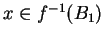 and
and  ,
,
where the reasons for the double implications are (1) definition
of , (2) definition of  , (3) definition of ,
(4) definition of .
, (3) definition of ,
(4) definition of .
In this proof we were able to use
 all the way through,
which is the shortest way. But often in proving two sets
all the way through,
which is the shortest way. But often in proving two sets  are equal it's necessary to show
 and
and
 separately, using one-way implications.