


Reminder: Midterm is in Haines A18.
Errata: In Handout J, J-8(b), the card numbers are A, 2, 3, 4, not A, 1, 2, 3. The reference should be to G-8, not G-9.
p. I 9, solution to E-5: line 3 should say
 .
.
p. L 1, solution to p. 15, Ex. 2: line 4 should say
 .
.
Solutions:
First, a comment on a situation that often arises.
Recall that an implication
 is
equivalent to the ``contrapositive'' form
not
is
equivalent to the ``contrapositive'' form
not not
not , in which
  and
and  are
negated and switched. The contrapositive of the
contrapositive is the original implication. Notice
that the contrapositive is equivalent to the
original; it is not the same as the opposite
implication
are
negated and switched. The contrapositive of the
contrapositive is the original implication. Notice
that the contrapositive is equivalent to the
original; it is not the same as the opposite
implication
 (the ``converse'').
Often a statement to be proved will have the form
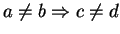 . It is often simpler and
clearer to prove the contrapositive:
. It is often simpler and
clearer to prove the contrapositive:
 .
.
For example, if you are asked to prove that a function  is
one-to-one, which says
is
one-to-one, which says
 , it is often better to prove the contrapositive
form
, it is often better to prove the contrapositive
form
 .
.
Other examples occur in the solutions below to problems about Latin squares.
Using the contrapositive is so frequent that in simple situations you can use it without calling attention to it.
The contrapositive can also be viewed as a version of proof by contradiction.
p. 66, Ex. 6. The row-reduced echelon form is
![$ \left[\begin{array}{rrrrr}1&7&0&3&0\\ 0&0&1&5&0\\ 0&0&0&0&1\\ 0&0&0&0&0\end{array}\right]$](img14.gif) .
.
(a) A basis for  consists of the nonzero rows of the
row-reduced echelon form. As the text does, let's call the
three nonzero rows
consists of the nonzero rows of the
row-reduced echelon form. As the text does, let's call the
three nonzero rows
 (rho's).
(b) The elements of are vectors of the form
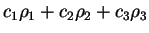 .
.
(c) For
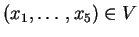 , using the fact that
we can see a pattern like the identity matrix in the first,
third, and fifth entries of
when compared, we see that the coefficients needed are
, using the fact that
we can see a pattern like the identity matrix in the first,
third, and fifth entries of
when compared, we see that the coefficients needed are
 .
.
Ex. 7. Let's write ![$ [A\vert Y]$](img20.gif) for the augmented matrix. We
know that row-reducing the augmented matrix doesn't change the
solutions, so we can work with its row-reduced echelon form
for the augmented matrix. We
know that row-reducing the augmented matrix doesn't change the
solutions, so we can work with its row-reduced echelon form
![$ [E\vert Z]$](img21.gif) . There are only two possibilities: (i) The
last row of looks like
. There are only two possibilities: (i) The
last row of looks like
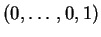 . In that
case there is an equation
. In that
case there is an equation  and the system (row-reduced
or not) cannot be solved. (ii) The rows of all
look like
and the system (row-reduced
or not) cannot be solved. (ii) The rows of all
look like
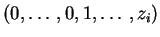 (perhaps with no 0's to
start but at least with the 1). In this case we can solve
for the pivot variables in terms of non-pivot variables and
constants, and there are solutions.
(perhaps with no 0's to
start but at least with the 1). In this case we can solve
for the pivot variables in terms of non-pivot variables and
constants, and there are solutions.
p. 73, Ex. 1. (b) and (e) are linear transformations, since each output coordinate is a linear combination of input coordinate values.
(a), (c), and (e) all fail the condition that
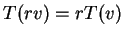 ,
for example if
,
for example if  and
and  is any nonzero value.
Ex's 2 and 3 are not on Midterm #1, although you do need to know the similar concepts for matrices. (For matrices we didn't talk about the range, but rather the column space, which turns out to be the same thing.) These problems are based on reading, to prepare for the discussion in class.
Ex. 2. Let
 dim. For the zero transformation, the
range is
dim. For the zero transformation, the
range is
 0
0 , the rank is 0, the null space is ,
and the nullity is
, the rank is 0, the null space is ,
and the nullity is  . For the identity transformation,
the range is , the rank is , the null space is
0,
and the nullity is 0.
. For the identity transformation,
the range is , the rank is , the null space is
0,
and the nullity is 0.
Ex. 3. For Example 2: Let's stick to
 ; I think the
problem is harder than intended otherwise. Notice that is
the space of all polynomial functions, not just polynomials up
to some degree. The range is and the null space is the
subspace of constant functions.
; I think the
problem is harder than intended otherwise. Notice that is
the space of all polynomial functions, not just polynomials up
to some degree. The range is and the null space is the
subspace of constant functions.
For Example 5: Notice that  , or
, or  , has the
property that
, has the
property that
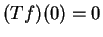 and also has a continuous
derivative, as mentioned in the text. The range consists of
all functions with these two properties. To see this,
let
and also has a continuous
derivative, as mentioned in the text. The range consists of
all functions with these two properties. To see this,
let  be such a function and consider
  , which
is given by
, which
is given by
 ,
by a version of the fundamental theorem of calculus. Thus
,
by a version of the fundamental theorem of calculus. Thus  and is in the range. The null space consists of all
functions with
and is in the range. The null space consists of all
functions with  , which says
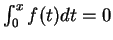 for all
  . Taking the derivative of both
sides we get
. Taking the derivative of both
sides we get  , again by a version of the fundamental
theorem of calculus. Therefore the null space consists only of
the 0 function.
, again by a version of the fundamental
theorem of calculus. Therefore the null space consists only of
the 0 function.