


p. 15
Ex. 2: This is practice for complex numbers. Remember,
 , and the conjugage of
  means
means  . For
. For
 , multiply top and bottom by the congugate of the
bottom, in this case
, multiply top and bottom by the congugate of the
bottom, in this case  . So
. So
 .
.
![$ A \rightsquigarrow \left[\begin{array}{cc}1&-i\\ 0&2+2i\\ 0&i\end{array}\right] \rightsquigarrow \left[\begin{array}{cc}1&0\\ 0&1\\ 0&0\end{array}\right]$](img7.gif) .
There are no nonpivot columns so the solution space of
.
There are no nonpivot columns so the solution space of  is
just
0.
is
just
0.
Ex. 3: The zero matrix;
![$ \left[\begin{array}{cc}1&r\\ 0&0\end{array}\right]$](img9.gif) for any
for any  ,
,
![$ \left[\begin{array}{cc}0&1\\ 0&0\end{array}\right]$](img11.gif) , and the identity matrix. The number of
pivot columns in the respective cases is 0, 1, 1, 2.
, and the identity matrix. The number of
pivot columns in the respective cases is 0, 1, 1, 2.
p. 49
Ex. 10. Proof #1: If
 are linear
dependent, one is a linear combination of the others so we can
delete it without changing the span. If they are still dependent,
we can delete another one, and so on. When we get down to a
spanning set that is not linearly dependent (a minimal spanning set),
that's a basis!
are linear
dependent, one is a linear combination of the others so we can
delete it without changing the span. If they are still dependent,
we can delete another one, and so on. When we get down to a
spanning set that is not linearly dependent (a minimal spanning set),
that's a basis!
Proof #2: Examine
in order.
Save each one that is not a linear combination of the preceding
ones you have saved, and discard the others. Since the missing
ones are linear combinations of others, omitting them doesn't
change the span. Since of the ones you have saved, each is not
in the span of the preceding, the ones saved are linearly
independent, by a lemma we have discussed. Since the saved
vectors span and are linearly independent, they are a basis.
Ex. 13. Suppose when you did Ex. 9 before, you used the method
that
 . This depended on solving simultaneous equations
 , and you found they have only the zero
solution. However, when you do it over GF(2) you'll find that
there is a nonzero solution,
, and you found they have only the zero
solution. However, when you do it over GF(2) you'll find that
there is a nonzero solution,  , so the three sums
of vectors are linearly dependent.
, so the three sums
of vectors are linearly dependent.
p. 66, Ex. 3. This is the same as §7 on Handout H. To repeat
the same method applied to the present problem: A system
of homogeneous equations is described by a matrix of coefficients.
What 4-tuples are eligible to be rows of this matrix? Such a
4-tuple  would have the property that it times each
of the three given vectors is 0:
would have the property that it times each
of the three given vectors is 0:
![$ \left[\begin{array}{rrrr}a&b&c&d\end{array}\right] \left[\begin{array}{r}-1\\ 0\\ 1\\ 2\end{array}\right] = 0$](img17.gif) ,
,
![$ \left[\begin{array}{rrrr}a&b&c&d\end{array}\right] \left[\begin{array}{r}3\\ 4\\ -2\\ 5\end{array}\right] = 0$](img18.gif) ,
,
![$ \left[\begin{array}{rrrr}a&b&c&d\end{array}\right] \left[\begin{array}{r}1\\ 4\\ 0\\ 9\end{array}\right] = 0$](img19.gif) . This is the same as
. This is the same as
![$ \left[\begin{array}{rrrr}a&b&c&d\end{array}\right]\left[\begin{array}{rrr}-1&3...
...&0\\ 2&5&9\end{array}\right] = \left[\begin{array}{rrr}0&0&0\end{array}\right]$](img20.gif) .
Transposing, this is the same as
.
Transposing, this is the same as
![$ \left[\begin{array}{rrrr}-1&0&1&2\\ 3&4&-2&5\\ 1&4&0&9\end{array}\right]
\le...
... c\\ d\end{array}\right] = \left[\begin{array}{r}0\\ 0\\ 0\end{array}\right]$](img21.gif) . You know how to find a basis for
the solution space; use that basis for the rows of your answer.
. You know how to find a basis for
the solution space; use that basis for the rows of your answer.
For Problem G-1:
(a) For
 , suppose
 are
a minimal spanning set for
are
a minimal spanning set for  . Since they do span , the
only thing left to show is that they are linearly independent.
We prove this by contradiction: If they were linearly dependent,
we know that one of them, say
. Since they do span , the
only thing left to show is that they are linearly independent.
We prove this by contradiction: If they were linearly dependent,
we know that one of them, say  , would be in the span of the others.
But then could be omitted from the list
without changing the span of the list, so the original list
would not have been minimal. This is a contradiction, so
must be linearly independent.
, would be in the span of the others.
But then could be omitted from the list
without changing the span of the list, so the original list
would not have been minimal. This is a contradiction, so
must be linearly independent.
(b) For
 , suppose
is a maximal linearly independent list off vectors in .
The only thing left to show is that they span . Given any
, suppose
is a maximal linearly independent list off vectors in .
The only thing left to show is that they span . Given any
 , consider the list
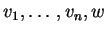 . Since
the original list was a maximal linearly independent set, the
new list, being larger, must be linearly dependent. In the
nontrivial linear relation, the coefficient of
. Since
the original list was a maximal linearly independent set, the
new list, being larger, must be linearly dependent. In the
nontrivial linear relation, the coefficient of  must be
nonzero, since a linear relation between
not involving must be trivial. Then we can solve for
as a linear combination of
, so
is in their span.
must be
nonzero, since a linear relation between
not involving must be trivial. Then we can solve for
as a linear combination of
, so
is in their span.
For Problem G-2:
Let
 . It has been mentioned that
  is called
the ``image'' of
is called
the ``image'' of  via
via  . We can also use the terminology
that the image of itself means the set of all images of
elements. For example, is onto if its image is all of
. We can also use the terminology
that the image of itself means the set of all images of
elements. For example, is onto if its image is all of
 .
.
For the statement about left inverses, direction
 :
Suppose has a left inverse
:
Suppose has a left inverse  , so that
 for
all
for
all  . If
. If
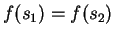 , then
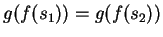 , which is the same as
 . Therefore
is one-to-one.
. Therefore
is one-to-one.
Direction
 : If is one-to-one, define
 as
follows. Given any
as
follows. Given any  , if
, if  for some (which
would be uniquely determined), let
for some (which
would be uniquely determined), let  ; if
; if  is not in
the image of , then let
is not in
the image of , then let  be any element of
  . Then
for all ,
. (The values of on the
part of outside the image of never make a difference.)
. Then
for all ,
. (The values of on the
part of outside the image of never make a difference.)
For the statement about right inverses, direction
:
Suppose has a right inverse so that
 for
all . Then each is the image of some ,
specifically
for
all . Then each is the image of some ,
specifically  . Therefore is onto.
Direction
: If is onto, define
as
follows. Given any , choose any with
(since there's at least one choice), and let be that .
Then for any we have
.
Note. As in calculus, if
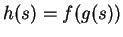 for all , we write
 and say
  is the composition of and .
We also can write
is the composition of and .
We also can write
 or just
 for the
``identity function'' on , which means the function taking
for the
``identity function'' on , which means the function taking
 for all . Then is a left inverse of when
 , and is a right inverse of when
 (this time meaning
 ). This notation
makes function inverses look more like mulitiplicative inverses.
). This notation
makes function inverses look more like mulitiplicative inverses.
For Problem G-3:
(a) As with other problems involving arithmetic progressions, the
row-reduced echelon form also has arithmetic progressions:
![$ \left[\begin{array}{ccccc}1&0&-1&\cdots&-8\\ 0&1&2&\cdots&9\\ 0&0&0&\cdots&0\\
\cdots &\cdots &\cdots &\cdots &\cdots \\ 0&0&0&\cdots&0\end{array}\right]$](img61.gif) So the rank is 2.
So the rank is 2.
(b) Rows are proportional and the matrix is not the zero matrix, so the rank is 1.
For Problem G-4:
(a)
 , with
0
, with
0 . The only subspace of dimension 0 is
 0
0 .
The only subspace of dimension 2 is
.
The only subspace of dimension 2 is  itself. To get a
1-dimensional subspace, we can take any nonzero vector
itself. To get a
1-dimensional subspace, we can take any nonzero vector  and
find the subspace it spans, specifically, each scalar times
. But the only scalars are 0 and 1, so we get
0
and
find the subspace it spans, specifically, each scalar times
. But the only scalars are 0 and 1, so we get
0 . There are three nonzero vectors to use, as
listed above, so we get three 1-dimensional subspaces.
. There are three nonzero vectors to use, as
listed above, so we get three 1-dimensional subspaces.
Note: If we were using GF(3) as the field, the 1-dimensional subspace
generated by a vector would be
0 , so that
two nonzero vectors would participate in each 1-dimensional
subspace.
, so that
two nonzero vectors would participate in each 1-dimensional
subspace.
(b)
 , with
0
, with
0 . As in (a), we get
one 0-dimensional subspace and one 3-dimensional subspace, and
just as in (a) the 1-dimensional subspaces are of the form
0 where is one of the seven nonzero vectors.
Each 2-dimensional subspace
. As in (a), we get
one 0-dimensional subspace and one 3-dimensional subspace, and
just as in (a) the 1-dimensional subspaces are of the form
0 where is one of the seven nonzero vectors.
Each 2-dimensional subspace  is the span of two nonzero
vectors
is the span of two nonzero
vectors  and has four elements:
 . There are seven possibilities:
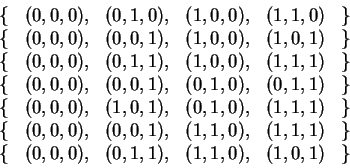
In each case, for and any two of the three nonzero vectors
will do.
For Problem G-5:
The addition and negation properties are the same as for fields.
Multiplication is associative and there is a neutral element  ,
but multiplication is not commutative (since
,
but multiplication is not commutative (since
 if
if
![$ A = \left[\begin{array}{rr}0&1\\ 0&0\end{array}\right]$](img78.gif) and
and  , for example), and nonzero elements
might not have multiplicative inverses (same matrices as
examples). The distributive law still holds.
, for example), and nonzero elements
might not have multiplicative inverses (same matrices as
examples). The distributive law still holds.
Exception: For
 matrices with
  , we do get
a field, isomorphic to
, we do get
a field, isomorphic to  .
.
Note. The laws that matrices do satisfy define what is called
a ``ring with 1''. So a field is really a commutative ring with 1
in which each nonzero element has a multiplicative inverse. Other
examples of commutative rings with 1 are the
 and the set
of all polynomials over
and the set
of all polynomials over
 , of all degrees.
For Problem G-6:
Following the suggestion, let
![$ \phi(a + bi) = \left[\begin{array}{rr}a&-b\\ b&a\end{array}\right]$](img85.gif) ,
for
,
for
 . Then
![$ \phi((a + bi) + (c + di)) = \phi
((a+c) + (b + d)i) = \left[\begin{array}{rr}a...
...left[\begin{array}{rr}c&-d\\ d&c\end{array}\right] = \phi(a+bi) + \phi(c + di)$](img87.gif) , so addition is
preserved. Also
, so addition is
preserved. Also
![$ \phi((a+bi)(c+di)) = \phi((ac-bd) + (bc+ad)i)
= \left[\begin{array}{rr}ac-bd&-bc-ad\\ bc+ad&ac-bd\end{array}\right]$](img88.gif) , while
, while
![$ \phi(a+bi)\phi(c+di)
= \left[\begin{array}{rr}a&-b\\ b&a\end{array}\right] \l...
...}\right] = \left[\begin{array}{rr}ac-bd&-bc-ad\\ bc+ad&ac-bd\end{array}\right]$](img89.gif) (the same), so multiplication is preserved.
(the same), so multiplication is preserved.  is one-to-one since
two
is one-to-one since
two
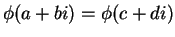 says
says
![$ \left[\begin{array}{rr}a&-b\\ b&a\end{array}\right] = \left[\begin{array}{rr}c&-d\\ d&c\end{array}\right]$](img92.gif) so
so  and
and  and so
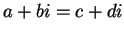 . (That was almost
too obvious to be written out.) is onto from the
definition of .
. (That was almost
too obvious to be written out.) is onto from the
definition of .
For Problem G-7:
See the notes for 1-M, on the web and handed out. In
 ,
,
 ,
,
 ,
,
 ,
,
 ,
,
 ,
,
 ,
,
 , so
1 is its own inverse, 2 and 7 are inverses of each other, etc.
, so
1 is its own inverse, 2 and 7 are inverses of each other, etc.
For Problem G-8: The intention of this problem was to do this in an ad-hoc way, just to get a sense of how it's tricky to do. An organized solution is in Problem J-8.
For Problem G-9: Again, the intention of this problem was just to get a sense of the difficulty. See Problem J-5.