


For Problem C-1:
Our list starts with  and
and  . Their
complements are
. Their
complements are  and
and  . Intersecting
two of these four sets at a time we get the empty set and
the singletons
. Intersecting
two of these four sets at a time we get the empty set and
the singletons  ,
,  ,
,  , and
, and  .
Taking unions of two or more singletons gives all other subsets
of
.
Taking unions of two or more singletons gives all other subsets
of  , including itself. ( can also be obtained
as the union of and its complement.)
, including itself. ( can also be obtained
as the union of and its complement.)
For Problem C-2:
If the unknown weights are  , we get equations
 , etc., from the first
four rows. The first four rows are the augmented matrix
of this system. Row-reducing over GF(2) =
, etc., from the first
four rows. The first four rows are the augmented matrix
of this system. Row-reducing over GF(2) =
 gives
gives
![$ \left[\begin{array}{rrrrr}1&0&0&0&\frac 3{20}\ 0&1&0&0&\frac 1{20}\ 0&0&1&0&\frac
7{25}\ 0&0&0&1&\frac {13}{25}\end{array}\right]$](img138.gif) so the weights are
so the weights are
 . Using these weights in the fifth row gives
the weighted average 93.
. Using these weights in the fifth row gives
the weighted average 93.
For Problem C-3:
Suppose that instead
 , say
, say
 with
with
 , in lowest terms (meaning that
  and
and  have no positive integer divisors in common except
  ). Then
 ,
,
 . Since
  is a prime
factor of
is a prime
factor of  , must be a prime factor of , so
 for some integer
  . Then
becomes
. Then
becomes
 . Cancel to get
 . Then
is a prime factor of
. Then
is a prime factor of  , and by the same reasoning as before,
must be a prime factor of , as it was of . But
then
, and by the same reasoning as before,
must be a prime factor of , as it was of . But
then  was not in lowest terms, a contradiction. We
conclude that
was not in lowest terms, a contradiction. We
conclude that
 . (We used the fact that
every positive integer can be expressed uniquely as a product of
primes, so involves the same primes as and involves
the same primes as .)
. (We used the fact that
every positive integer can be expressed uniquely as a product of
primes, so involves the same primes as and involves
the same primes as .)
For Problem C-4:
As suggested, let
 as a set and use the usual
  and
and
 , but make a fudged product by scalars in which a scalar times a
vector is always
0. Since every defining law of vector
spaces except
, but make a fudged product by scalars in which a scalar times a
vector is always
0. Since every defining law of vector
spaces except  involves a product by scalars on either
both sides or neither side, all those laws are still true. However,
the law fails for any choice of a nonzero
involves a product by scalars on either
both sides or neither side, all those laws are still true. However,
the law fails for any choice of a nonzero  ,
since the left-hand side is
0 and right-hand side is not.
,
since the left-hand side is
0 and right-hand side is not.
For Problem C-5:
(a) The subspace spanned is the whole space, because for any
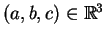 , the equation
 gives
gives
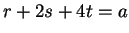 ,
,
 ,
,  ,
which can always be solved by finding
,
which can always be solved by finding  , then
  , then
  .
.
(b) The subspace spanned is again the whole space, because for any
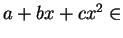 Pols
Pols , the equation
 gives the same equations as in (a) and so can be solved.
(c) The subspace spanned is again the whole space, because for any
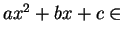 Pols, the equation
 gives the same equations as in (a) and so can
be solved. [If you write polynomials in some other order you get
different equations but they are solved similarly.]
gives the same equations as in (a) and so can
be solved. [If you write polynomials in some other order you get
different equations but they are solved similarly.]