


Problem. Find a matrix  whose null space is the
span of
whose null space is the
span of
![$ \left[\begin{array}{r}1\\ 2\\ 1\\ 2\\ 3\end{array}\right]$](img28.gif) ,
,
![$ \left[\begin{array}{r}2\\ 4\\ 3\\ 7\\ 8\end{array}\right]$](img29.gif) , and
, and
![$ \left[\begin{array}{r}1\\ 2\\ 3\\ 8\\ 8\end{array}\right]$](img30.gif) .
.
Discussion. should have five columns; we don't yet
know how many rows. Concentrate on one row of ;
since it's unknown, call it
x![$ = \left[\begin{array}{rrrrr}x&y&z&s&t\end{array}\right]$](img31.gif) .
When we multiply it by any of the three given column vectors
we are supposed to get 0. Since
x times a matrix equals
x
times each column of the matrix, if we let
.
When we multiply it by any of the three given column vectors
we are supposed to get 0. Since
x times a matrix equals
x
times each column of the matrix, if we let  be the
matrix with the given vectors as columns we have
x
be the
matrix with the given vectors as columns we have
x![$ A =
\left[\begin{array}{rrr}0&0&0\end{array}\right]$](img33.gif) . This equation describes the space of all row
vectors eligible to be a row of . So we should choose
to have rows that are a basis for this space. How? Just
transpose to get a more familiar kind of problem, a matrix
times an unknown column vector:
. This equation describes the space of all row
vectors eligible to be a row of . So we should choose
to have rows that are a basis for this space. How? Just
transpose to get a more familiar kind of problem, a matrix
times an unknown column vector:
 x
x 0. (Here we used the idea
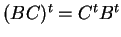 .) Now we
know what to do:
.) Now we
know what to do:
Method. Make with the given vectors as columns, find
a basis for the null space of , and use those basis
vectors as the rows of . (In doing that we're transposing
the basis vectors to make them row vectors.)