


Quiz 3 in discussion section, Tuesday, October 16:
You will be asked to do some problem like E-1 and p. 49 Ex. 9, but with messier coefficients, two ways: (a) directly, (b) using isomorphism. For sample proofs, see the on-line notes for 2-W.
Assignment due in lecture Wednesday, October 17:
| where | Do but don't hand in | Hand in |
| p. 15 | 2,3 | |
| p. 49 | 10, 13 | |
| p. 66 | 3 | |
| G | G-5 | G-1, G-2, G-3, G-4, G-6, G-7, G-8, G-9 |
Problem G-1. In the first Theorem on Handout F, show
(a)
 ;
;
(b)
 .
.
Problem
G-2. For a function
 between sets, a function
 is
a left inverse of
is
a left inverse of  if
if
 for all
  ,
or a right inverse if
,
or a right inverse if
 for all
  .
.
Show that has a left inverse
 is one-to-one, and
a right inverse
is onto. (In both cases there may
be some choice involved in making
is one-to-one, and
a right inverse
is onto. (In both cases there may
be some choice involved in making  , so is not necessarily unique.)
Note. If is both one-to-one and onto, then has a
unique ``two-sided'' inverse , which we call  , as in E-5.
Problem
G-3. Find the rank of the
 matrices consisting of
(a) the addition table for integers
 :
:
![$ \left[\begin{array}{cccc}0&1&\cdots&9\\ 1&2&\cdots&10\\ \cdots&\cdots&\cdots &\cdots\\ 9&10&\cdots&18\end{array}\right]$](img15.gif)
(b) the multiplication table for integers
:
![$ \left[\begin{array}{cccc}0&0&\cdots&0\\ 0&1&\cdots&9\\ \cdots&\cdots& \cdots &\cdots\\ 0&9&\cdots&81\end{array}\right]$](img16.gif)
Problem
G-4. Let
 .
.
(a) Show that the vector space  has five subspaces. (Don't
forget the subspace
has five subspaces. (Don't
forget the subspace
 0
0 .)
.)
(b) Show that the vector space  has sixteen subspaces--even
though the vector space itself has only eight elements! (Describe
subspaces using bases.)
has sixteen subspaces--even
though the vector space itself has only eight elements! (Describe
subspaces using bases.)
Problem
G-5. If you take all square matrices of a fixed size, say
 , with entries in some field
  , you can both add
them and multiply them. Which of the field properties described
on pages 1 and 2 hold? (Not all do! No proofs required.)
, you can both add
them and multiply them. Which of the field properties described
on pages 1 and 2 hold? (Not all do! No proofs required.)
Problem
G-6. If you take just some
matrices with entries
in a field , they might form a field themselves. The first
requirement is that your set of matrices should be closed under
addition and multiplication.
Show that the field
 of complex numbers is isomorphic to
the set of all real matrices of the form
of complex numbers is isomorphic to
the set of all real matrices of the form
![$ \left[\begin{array}{rr}a&-b b&a\end{array}\right]$](img25.gif) .
.
(This means isomorphic as fields. Method: Let  be this
set of matrices. Define a function
be this
set of matrices. Define a function
 in some
reasonable way, saying
in some
reasonable way, saying
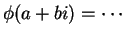 . (Mathematicians in the
U.S. usually pronounce
. (Mathematicians in the
U.S. usually pronounce  as ``fee'' rather than ``fi''.) Make
sure is one-to-one and onto and preserves the relevant
operations. Although you could check directly that is closed
under matrix
as ``fee'' rather than ``fi''.) Make
sure is one-to-one and onto and preserves the relevant
operations. Although you could check directly that is closed
under matrix  and
and  , this actually follows automatically
from the fact that preserves operations; for example
, this actually follows automatically
from the fact that preserves operations; for example
 .)
.)
Problem
G-7. In
 , find the multiplicative inverse of each nonzero
element.
, find the multiplicative inverse of each nonzero
element.
The next two problems are warm-ups for future problems.
Problem
G-8. From a deck of playing cards, take Ace (= 1), 2, 3, 4 of all
four suits. Find an arrangement of these cards as follows: The
cards are laid in a
 square. Each row of the
square has four different suits and four different numbers. So
does each column.
square. Each row of the
square has four different suits and four different numbers. So
does each column.
Problem G-9. In statistical experiments involving, say, plants, it is helpful to be able to overlap various conditions in an efficient but uniform way. For example, show how to take a set of seven plants and designate seven blocks of three plants each so that (i) any two plants are in exactly one block and (ii) any two blocks have exactly one plant in common. (Then one block could be ``extra sun'', one could be ``extra water'', one could be ``rich soil'', etc.)