


As usual, Netscape may work better than Internet Explorer for these.
A (single) harmonic oscillator means motion obeying
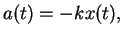
 is a positive constant. In other words, acceleration is
proportional to position, but negatively, so that the moving
point is always being pushed back towards the origin. Since
acceleration is the second derivative of position, the DE says
is a positive constant. In other words, acceleration is
proportional to position, but negatively, so that the moving
point is always being pushed back towards the origin. Since
acceleration is the second derivative of position, the DE says


 is the length of time for
 to go from
0 to
to go from
0 to  , so
, so

If we consider ``linked'' harmonic oscillators, where there are two or more oscillators and the acceleration of each depends on the position of all of them, the motion gets much more complicated--and yet it is easily understood using eigenvalues.
Problem FF-1. Try the ``double oscillator demo'' on the course home page.
The double oscillator represents two linked harmonic oscillators:
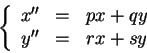
or for short,
x x. This motion can be nonperiodic and
seemingly crazy, but there is an underlying regularity exposed by
the eigenvectors.
x. This motion can be nonperiodic and
seemingly crazy, but there is an underlying regularity exposed by
the eigenvectors.
View 1: You see just the oscillators, going crazy, never repeating.
View 2: Oscillators and acceleration vectors. Still crazy.
View 3: Positions shown on perpendicular axes, so that the coordinates of one moving dot can represent positions of both oscillators at once.
View 4: Shows track of the dot. Let it go for a while. Now it becomes clearer that there is some regularity.
View 5: Shows position and acceleration vectors. Not so clear again.
View 6: Shows position and acceleration vectors and their components on eigenspaces. Notice that the components are periodic, but of different periods. In other words, the crazy motion is really the vector sum of two periodic motions of incompatible periods.
In this view, you can click on ``Set'', drag the red dot to any position you wish, and click on ``Go'' to resume. Remember, doing this is equivalent to starting eachof the original two oscillators in position.
Write down what happens when you put the red dot on an eigenspace and then resume. Try both eigenspaces. Are the periods the same? If you back up to the initial view, you should see the same periodic motion.
Note. This demo is purely visual. However, these DE's can be
diagonalized just like a first-order system. The eigenvalues are
negative and play the role of in the single oscillator solution.
Thus the eigenvalues determine the periods of the two underlying periodic
oscillations. Specifically, each eigenvalue
 is like
 , so
, so

Problem
FF-2. Try the ``multiple oscillator demo'' on the course home page.
Having selected it, click on the bar to start it. You should see
four linked oscillators, obeying  for a random symmetric
matrix
for a random symmetric
matrix  with negative eigenvalues. The motion will be
non-periodic. The purpose of this demo is to see that you get
periodic motion when the initial conditions correspond to an
eigenvector.
with negative eigenvalues. The motion will be
non-periodic. The purpose of this demo is to see that you get
periodic motion when the initial conditions correspond to an
eigenvector.
(a) Try stopping the motion with ``Set'', dragging one or more of the dots to a new position, and restarting with ``Go''. Does that have much effect on the kind of motion, e.g., faster or slower?
(b) Go ``Forward'' to see the matrix. Diagonalize the matrix and
select a column of  (an eigenvector). Then go back. You
will see the same motion but with arrows representing the four
coordinates of the eigenvector.
(an eigenvector). Then go back. You
will see the same motion but with arrows representing the four
coordinates of the eigenvector.
Stop the motion, drag the dots to the arrows, and restart. You should see periodic motion.
(c) Repeat (b) for a different column (eigenvector). Does that affect the period? It should, since the eigenvalue for that eigenvector determines the period, as described above.