


Definition. Let  be a vector space over a field
  .
A list of vectors
.
A list of vectors
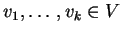 is a basis for if
 are linearly independent and span .
Theorem. The following conditions are equivalent, for
 in a vector space .
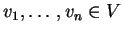
(1)
form a basis for .
(2) Every element of can be written uniquely as a
linear combination of
.
(3) There is an isomorphism of  with such that
the standard basis vectors
with such that
the standard basis vectors
 of correspond
to
of correspond
to
 .
.
(4)
are a minimal spanning set, in the sense that
if any one of them is omitted then the remaining vectors do not
span .
(5)
is a maximal linearly independent set, in
the sense that if any vector in is added to the list, the
new list is linearly dependent.
Lemma. If has a basis with  elements, then
any
elements, then
any  elements of are linearly dependent.
Theorem. If has a basis with elements, then
any other basis also has elements.
Definition. If has a basis with elements, we say
has dimension over .
Notes. (a)
By the Theorem, there is no ambiguity about what the dimension is.
(b) Some vector spaces, such as the vector space
 of continuous functions, are infinite
dimensional; there is no finite basis.
of continuous functions, are infinite
dimensional; there is no finite basis.
Useful observation: In a linearly dependent list of vectors, some vector is in the span of the preceding vectors in the list. Or to put it the other way around, if a list of vectors has the property that no member is in the span of the preceding ones, it is linearly independent.
(What does ``the span of the preceding ones'' mean in the case of the first vector in the list?)
Developing Intuition
If you develop intuition based on
 , it should be a good
guide to what is true about finite-dimensional vector spaces in
general (except for facts that depend on the dimension of the
whole space being 3!)
, it should be a good
guide to what is true about finite-dimensional vector spaces in
general (except for facts that depend on the dimension of the
whole space being 3!)
Try these. Where one is false, think of a counterexample. Where one is true, see if you can prove it.
True or false?
1. A subspace of a finite-dimensional vector space is always finite-dimensional.
2. For three vectors
 in a vector space ,
if each two are linearly independent, then the three are linearly
independent.
in a vector space ,
if each two are linearly independent, then the three are linearly
independent.
3. If
span , then some subset of them
is a basis for .
4. If
are a basis of and  is a
subspace of , then some subset of
is a
subspace of , then some subset of
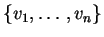 is
a basis for .
is
a basis for .
5. If
 Span
Span , then
Span
, then
Span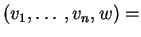 Span.
Span.
6. If
are linearly independent in a finite-dimensional
vector space , then this list can be extended to a basis.
7. Any linearly independent list of vectors is a basis for the subspace they span.
8. If  are subspaces of a finite-dimensional vector
space , then
dim
are subspaces of a finite-dimensional vector
space , then
dim dim
dim dim.
dim.
9. If
Span Span
Span then
then
 for
some scalar
for
some scalar  .
.
10. For any two 2-dimensional subspaces of a vector space, their intersection contains a nonzero vector.