


Office hours: These will now be Monday 1:30-2:30, Tuesday 1:30-2:30, and Thursday 2:30-3:30.
Quiz 2 in discussion section, Tuesday, October 9: You will be asked to do some proof from p. 31.
Assignment due in lecture Wednesday, October 10:
| where | Do but don't hand in | Hand in |
| p. 5 | 8 | |
| p. 48 | 1, 2, 5, 12 | 3, 4, 7, 9 |
| E | E-3, E-5, E-6 | E-1, E-2, E-4, E-7, E-8 |
Problem
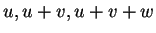
E-1. Show that if
 are linearly independent,
so are
are linearly independent,
so are
 .
.
Problem
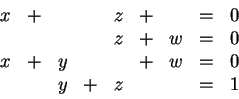
E-2. Over GF(2) (in other words, over
 ), solve these
simultaneous equations, if that's possible, and check your
answer:
), solve these
simultaneous equations, if that's possible, and check your
answer:
Problem
E-3. Over
 , for the matrix

(Method: Row reduction doesn't change the row space or the null space, and it doesn't change the linear relations between columns. Careful, though: It does change the column space.)
Problem
E-4. A function
 (where
  and
and  are any sets)
is said to be ``one-to-one'' if distinct
are any sets)
is said to be ``one-to-one'' if distinct
 go to
distinct values
go to
distinct values
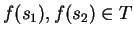 ; in other words,
 .
.
The function  is said to take ``onto'' (`` is
onto'') if every element of is the image of some element of
; in other words, for each
is said to take ``onto'' (`` is
onto'') if every element of is the image of some element of
; in other words, for each  there is at least
one
there is at least
one  with
with  .
.
If is both one-to-one and onto, then is said to
be a ``one-to-one correspondence'' between and . In
other words, each element of corresponds to exactly one
element of and vice versa. In this case, there is an
``inverse function''
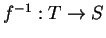 that undoes and
is also a one-to-one correspondence.
that undoes and
is also a one-to-one correspondence.
In the following examples, say whether is one-to-one,
onto, or both.
(a)
 given by
 .
.
(b)
given by
 .
.
(c)
given by
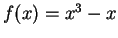 .
.
(d)
given by
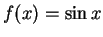 .
.
(e)
given by
 .
.
(It may be helpful to think of the graphs of these functions.)
Problem
E-5. Prove that if
is a one-to-one correspondence,
so is the function
 defined by saying
  is
the unique for which . (Therefore we can
define
is
the unique for which . (Therefore we can
define  to be this
  .)
.)
Problem
E-6. A function between vector spaces is usually called a
``transformation''. A transformation
 between
vector spaces is said to be a linear transformation if
it is compatible with the vector space operations, in the
sense that
between
vector spaces is said to be a linear transformation if
it is compatible with the vector space operations, in the
sense that
 for every
 , and
, and
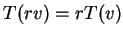 for every
  and
and  .
.
An
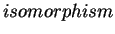 of vector spaces
  and
and  is a
linear transformation
that is also a one-to-one
correspondence. In that case, we say that and are
isomorphic and we write
is a
linear transformation
that is also a one-to-one
correspondence. In that case, we say that and are
isomorphic and we write  .
.
Examples:
 Mats
Mats .
.
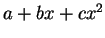 ,
,
 Pols
Pols , using
 Pols defined
by
Pols defined
by
 .
.
 Pols defined
by
Pols defined
by
 .
.
If two vector spaces are isomorphic, then anything we can say about vectors in one can be transferred over to vectors in the other.
The problem: Prove that if
is an isomorphism, then so is  .
.
Problem E-7. Re-do Problem C-5, parts (b) and (c), using the idea of isomorphism. The shorter your answers, the better!
Problem
E-8. (a) Find the mystery
 matrix
  with entries
in
if
with entries
in
if
(i) is in row-reduced echelon form;
(ii) each of columns 1, 3, 5 of is not in the span of the
preceding columns;
(iii) column 2 of is 3 times column 1; column 4 is 2 times
column 1 plus 5 times column 3; and column 6 is minus column 1
plus 7 times column 3 minus 4 times column 5.
(b) Explain: A matrix in row-reduced echelon form is uniquely determined by knowing what linear relations hold between its columns. (You can give an informal explanation, rather than trying to give careful descriptions of matrices in row-reduced echelon form, but do mention all important issues.)
(c) It is a fact that row reduction of a matrix does not affect linear relations between columns. Using this fact and (b), prove that the row-reduced echelong form of a matrix is unique. In other words, if two people independently row-reduce a matrix to row-reduced echelon form, they must get the same answer!