


A quadratic expression such as
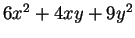 is said to be a ``quadratic form''.
A quadratic form can be rewritten as
x x, where
  is symmetric and
x
is symmetric and
x![$ = \left[\begin{array}{c}x\\ y\end{array}\right]$](img44.gif) (a column vector) so
x
(a column vector) so
x is a row
vector. For example,
is a row
vector. For example,
![$ 6x ^ 2 + 4 xy + 9y ^ 2 =
\left[\begin{array}{cc}x&y\end{array}\right] \left[\b...
...{rr}6&2\\ 2&9\end{array}\right] \left[\begin{array}{c}x\\ y\end{array}\right]$](img46.gif) . (Try multiplying out to check.)
The coefficient of
. (Try multiplying out to check.)
The coefficient of  is split in half and each half becomes an
off-diagonal entry.
is split in half and each half becomes an
off-diagonal entry.
To analyze the graph of an equation such as
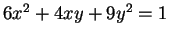 ,
write it in matrix form, diagonalize the matrix, and make the substitution
x
,
write it in matrix form, diagonalize the matrix, and make the substitution
x r, where
  is a rotation matrix.
Example: Describe the graph of
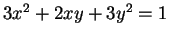 .
.
Solution: Rewrite as
x x for
for
![$ A = \left[\begin{array}{cc}3&1\\ 1&3\end{array}\right]$](img21.gif) .
We saw that
.
We saw that
 for
for
 and
and
![$ D = \left[\begin{array}{rr}4&0\\ 0&2\end{array}\right]$](img23.gif) . Substitute in
x r. We get
. Substitute in
x r. We get
 r
r r
r , or
r
, or
r r.
Since
r.
Since
 , we get
r
, we get
r r, or
r, or
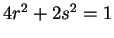 . This
can be rewritten as
. This
can be rewritten as
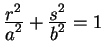 for
for
 ,
,
 ,
,
so the shape is an ellipse with semimajor axis
 and semiminor axis
 . But the ellipse is slanted. How?
Since
. But the ellipse is slanted. How?
Since  , the end of the semimajor axis is where
  ,
,
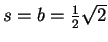 ; here
x
; here
x![$ = R \left[\begin{array}{c}0\\ {\frac 1 2}\sqrt
2\end{array}\right] = [$](img67.gif) v
v v
v![$ _ 2] \left[\begin{array}{c}0\\ {\frac 1 2}\sqrt 2\end{array}\right] = {\frac 1 2}\sqrt 2$](img69.gif) v
v , where
v is the second eigenvector, which
is the same as the second column of . Therefore the end of
the semimajor axis of is at
, where
v is the second eigenvector, which
is the same as the second column of . Therefore the end of
the semimajor axis of is at
![$ {\frac 1 2}\sqrt 2 \left[\begin{array}{c}-{\frac 1 2}\sqrt
2\\ {\frac 1 2}\sq...
...y}\right] = \left[\begin{array}{c}-{\frac 1 2}\\ {\frac 1 2}\end{array}\right]$](img71.gif) . You can check that this
point is on the graph.
. You can check that this
point is on the graph.
Problem DD-7. In this example, find the end of the semiminor axis.
Problem
DD-8. (a) In general, the transformed equation is
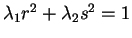 . Explain why, by discussing the substitution.
(b) How can you tell from the eigenvalues whether the equation is going to be an ellipse or a hyperbola or maybe some degenerate case? (In fact, what kinds of graphs can arise from (a)?)
Problem
DD-9. (a) Describe the shape of the graph of
. If it is an ellipse, give semimajor and
semiminor axis lengths. (For this you can use eigenvalues
alone.)
(b) How is this graph slanted? (You'll need the eigenvectors.)