


Definition. A list of vectors in
R is
orthonormal if the vectors are mutually perpendicular and
all of length 1.
is
orthonormal if the vectors are mutually perpendicular and
all of length 1.
It can be shown that orthonormal vectors are linearly independent.
Recall that you can test perpendicularity (orthogonality) of two vectors by checking that their dot product is 0; also, the dot product of a vector with itself is its length squared. Therefore:
Vectors
v v
v are orthonormal

 v
v v
v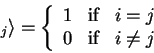
Definition. An
 matrix
  is a rotation matrix
if
is a rotation matrix
if
(i) the columns of are orthonormal, and
(ii)
 .
.
For
 matrices, rotations are just what you are used
to,
matrices, rotations are just what you are used
to,
 . However, using (i) and (ii) you can tell
if a matrix is a rotation matrix without knowing the angle. For
example,
. However, using (i) and (ii) you can tell
if a matrix is a rotation matrix without knowing the angle. For
example,
![$ R = \left[\begin{array}{rr}\frac 35&-\frac 45\\ \frac 45& \frac 35\end{array}\right]$](img17.gif) is a
rotation, as you can check.
is a
rotation, as you can check.