


Quiz 1-T, October 2. Be able to find the general solution to a set of linear equations, using row reduction--even if the system is not square or is square but singular.
Read/Review Chapter 1, handouts B and D, and start Chapter 2.
Homework due in lecture Wednesday, October 3.
In this course, you should always give your reasoning, even if a problem doesn't explicitly say to.
| where | Do but don't hand in | Hand in |
| p. 5 | 5, 7 | |
| p. 33 | 1, 5 | |
| p. 39 | 1, 4, 5 | 2, 3 |
| B | B-3, B-5 | B-1, B-2, B-4 |
| C | C-5 | C-1, C-2, C-3, C-4 |
| D | D-1 | D-2 |
Problem
C-1. Consider the set
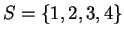 . Starting from
the subsets
. Starting from
the subsets  and
and  and using the
set operations of union
and using the
set operations of union  , intersection
  , and
complementation
, and
complementation  (repeatedly), how many different subsets
of
(repeatedly), how many different subsets
of  can you make? (Give your reasoning.)
Problem C-2. You find a torn page from an instructor's gradebook, with the data shown below. The last average is torn off. What is it? (These are weighted averages.)
| labs | hmwk | midt | final | avg |
| 12 | 24 | 25 | 25 | 23 |
| 50 | 30 | 26 | 36 | 35 |
| 60 | 60 | 75 | 100 | 85 |
| 40 | 80 | 50 | 75 | 63 |
| 60 | 80 | 100 | 100 |
Problem
C-3. Prove that for any prime number  ,
,
 Q.
(Use any reasonable facts about numbers that do or do not have
in their prime factorizations.)
Q.
(Use any reasonable facts about numbers that do or do not have
in their prime factorizations.)
Problem
C-4. Show that in the definition of a vector space, the law
 cannot be proved from the other laws. (You may assume
that the vector space is over
cannot be proved from the other laws. (You may assume
that the vector space is over
 .)
.)
(Method: Make an example of a set  with an operation
  and
multiplication by scalars in
for which fails but
all other defining laws for a vector space are true.
and
multiplication by scalars in
for which fails but
all other defining laws for a vector space are true.
Suggested way: Take
 and fudge it by using as usual
but declaring that multiplication by scalars always gives the
result
0. Of course, to have a good list of laws for a
definition, no law listed should be provable from all other
laws. This problem verifies just one instance of this goal.)
and fudge it by using as usual
but declaring that multiplication by scalars always gives the
result
0. Of course, to have a good list of laws for a
definition, no law listed should be provable from all other
laws. This problem verifies just one instance of this goal.)
Problem
C-5. (a) What is the subspace of
 spanned by
  ,
,
 , and
, and  ? (Give a simpler description.)
(b) What is the subspace of the set
Pols of degree
at most 2 that is spanned by
of degree
at most 2 that is spanned by  ,
,  , and
, and
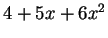 ?
?
(c) What is the subspace of the
Pols spanned by
 ,
,  , and
, and
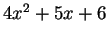 ?
?