


Questions on grading are welcome, even for one point. Please write any questions on the front of the exam and hand it back to me by the end of week 9.
Again, no letter grades are actually recorded, but estimated ranges would be C- to C 18-26, B- to B+ 27-37, A- to A 38-50.
All problems were from homework or ``proofs to know''. References:
1. Hw 6, p. 26, Ex. 1; see p. Y3.
2. (a) Hw 5, p. 73 Ex. 8; (b) Hw 7 p. 95, Ex. 2.
3. (a) Hw 6, Q-7; (b) from proofs to know.
4. From proofs to know.
5. (a) Hw 6, R-2 (see p. Y9); (b) Hw 5, O-3; (c) Hw 4, J-3 and Hw 6, Q-1; (d) Hw 6, p. 21, Ex. 7 and Hw 7, V-9.
Solutions.
1. Method #1: Find the elementary matrices which, when
multiplied on the left, change  to RREF. Then multiply
the elementary matrices together to get
to RREF. Then multiply
the elementary matrices together to get  . [Details omitted]
Method #2: Row-reduce
![$ [A\vert I] \rightsquigarrow [PA\vert P]$](img3.gif) , as follows:
, as follows:
![$ \left[\begin{array}{rrrrrrrr}1&2&1&5&9&1&0&0\\ 1&2&2&7&14&0&1&0\\ 1&2&1&5&9&...
...&0&0\\ 0&0&1&2&5&-1&1&0\\ 0&0&0&0&0&-1&0&1\end{array}\right]
\rightsquigarrow$](img4.gif)
![$ \left[\begin{array}{rrrrrrrr}1&2&0&3&4&2&-1&0\\ 0&0&1&2&5&-1&1&0\\ 0&0&0&0&0&-1&0&1\end{array}\right]$](img5.gif) ,
so the answer is
,
so the answer is
![$ P = \left[\begin{array}{rrr}2&-1&0\\ -1&1&0\\ -1&0&1\end{array}\right]$](img6.gif) .
.
Check:
![$ PA = \left[\begin{array}{rrr}2&-1&0\\ -1&1&0\\ -1&0&1\end{array}\right]\left...
...\left[\begin{array}{rrrrr}1&2&0&3&4\\ 0&0&1&2&5\\ 0&0&0&0&0\end{array}\right]$](img7.gif) ,
,
which is in RREF.
2. (a) Let
 with
with
![$ A = \left[\begin{array}{rrr}2&8&0\\ 3&1&0\\ 7&4&0\end{array}\right]$](img9.gif) .
.
Reason this is valid: The range of  is the column
space of , which is the span of the first two columns of
since the third column is
0.
is the column
space of , which is the span of the first two columns of
since the third column is
0.
(b)
![$ \tau _ A (v _ 1) = \left[\begin{array}{rr}1&1\\ 0&1\end{array}\right]\left[\b...
...{r}1\\ 1\end{array}\right] + s \left[\begin{array}{r}1\\ -1\end{array}\right]$](img11.gif) . This gives
. This gives  ,
,  ; solving we get
  ,
,
 ,
,
 .
.
![$ \tau _ A (v _ 2) = \left[\begin{array}{rr}1&1\\ 0&1\end{array}\right]\left[\b...
...{r}1\\ 1\end{array}\right] + u \left[\begin{array}{r}1\\ -1\end{array}\right]$](img17.gif) . This gives
. This gives  ,
,
 ; solving we get
  ,
,
 ,
,
 .
.
Putting these results together, we see that the matrix of  with respect to the basis
 is
is
![$ M = \left[\begin{array}{rr}
\frac 32& -\frac 12\\ \frac 12& \frac 12\end{array}\right]$](img25.gif) .
.
3. (a)  , so
, so
 . But which element is
 (the multiplicative inverse of 5) in
 ?
Using the Euclidean algorithm idea, we have
?
Using the Euclidean algorithm idea, we have
![$ \left[\begin{array}{rrr}31&1&0\\ 5&0&1\end{array}\right] \rightsquigarrow \le...
...t] \rightsquigarrow
\left[\begin{array}{rrr}1&1&-6\\ 0&-5&31\end{array}\right]$](img30.gif) . Expressing
. Expressing  as a
linear combination of
as a
linear combination of  and
and  we get
 , so
, so
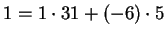 . Working modulo 31, this becomes
 in
. Since
in
. Since  in
, the answer is that
in
, the answer is that  .
.
(b) We use the Lemma that a list of vectors
 is linearly dependent
 some vector is in the span
of the preceding vectors.
some vector is in the span
of the preceding vectors.
Consider
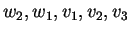 . Since
the original list of vectors already spanned
. Since
the original list of vectors already spanned  ,
,  is in that span, so this list is linearly dependent. Then by
the Lemma, some vector in the list is in the span of the
preceding vectors. That vector can't be
is in that span, so this list is linearly dependent. Then by
the Lemma, some vector in the list is in the span of the
preceding vectors. That vector can't be  or , since they are in a linearly independent set of vectors and
so are linearly independent. Therefore it must be some
or , since they are in a linearly independent set of vectors and
so are linearly independent. Therefore it must be some  . Then that can be removed without changing the
span, which is therefore still .
. Then that can be removed without changing the
span, which is therefore still .
4. (a) Since
 are in the range of ,
there are
are in the range of ,
there are  ,
,  with
with
 for
for  . The proposed basis is
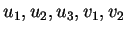 .
.
(b) To show that the vectors in (a) are linearly independent, we
suppose that a linear combination of them is
0 and try to
show that the coefficients are all zero. So suppose that for
scalars
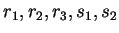 we have
(*)
 0.
0.
Applying and using the fact that is linear, we get
0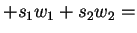 0 in
0 in  .
Since
are a basis of
Range
.
Since
are a basis of
Range , they
are linearly independent, so
, they
are linearly independent, so
 . Then
(*) becomes
. Then
(*) becomes
0 0. Since
 are a basis for the
null space of , they are linearly independent, so
.
are a basis for the
null space of , they are linearly independent, so
.
Therefore in (*) all coefficients must be 0, and we have proved the linear independence of the vectors from (a).
5. (a) We know
![$ p(D) =
\left[\begin{array}{ccc}p(1)&0&0\\ 0&p(0)&0\\ 0&0&p(-1)\end{array}\right]$](img60.gif) , so we want
, so we want  ,
,  ,
,  . In other words,
  has
roots
has
roots  . Then an answer is
 .
.
(b) We know that (i)
 subspace
 is a subspace and (ii)
 subspace is a subspace. Putting these together, we
see that
subspace is a subspace. Putting these together, we
see that
 is a subspace. It's a subspace of
since we went right and then left.
is a subspace. It's a subspace of
since we went right and then left.
(Everyone needs more work on what  means. If
is invertible then is actually another linear transformation.
But whether is invertible or not, if
means. If
is invertible then is actually another linear transformation.
But whether is invertible or not, if  is a subspace of ,
 means the set of all
  with
with
 ,
and it's a subspace. This is an application of the notation
,
and it's a subspace. This is an application of the notation  for subsets.)
(c) This says that for any nonzero vector
 there is
a
there is
a
 so that
  is nonsingular, i.e., has
rank 2. This can't be true, since we know has rank 1.
(Recall from homework that has rank 1 since the
rows are all proportional to each other.)
is nonsingular, i.e., has
rank 2. This can't be true, since we know has rank 1.
(Recall from homework that has rank 1 since the
rows are all proportional to each other.)
(d) If
![$ A = \left[\begin{array}{rr}a&b\\ c&d\end{array}\right]$](img80.gif) we know that
we know that
![$ A^{-1} = {\frac{\displaystyle 1}{\displaystyle \Delta}}
\left[\begin{array}{rr}d&-b\\ -c&a\end{array}\right]$](img81.gif) , where
, where
 det
det . Since we are told
 , the entries of
  are all plus or minus entries
of , so are integers. Therefore the answer is ``yes''. (To do this
problem, it's not necessary to remember the details of the entries of
, just the general idea.)
are all plus or minus entries
of , so are integers. Therefore the answer is ``yes''. (To do this
problem, it's not necessary to remember the details of the entries of
, just the general idea.)