in The Lord of the Rings: The Fellowship of the Ring
Introduction
A lot of people say that movie adaptations are never as good as the books. This is true for the most part. The Lord of the Rings, however, is a notable exception.
Peter Jackson’s The Lord of the Rings film trilogy is widely regarded as one of the greatest films ever made; the cinematography, the story, and the score are
defining characteristics of the film. In particular, Howard Shore’s score and many motifs set the tone of the films and makes the viewer feel immersed in the adventures
in Middle-earth.
There are many defining recognizable soundtracks in the film trilogy, but “Weathertop” isn’t usually one that comes to one’s mind. However, every time
I rewatch the movies (The Lord of the Rings: The Fellowship of the Ring, in particular), this theme always surprises me for its frightening, dread, and foreboding tone.
Without spoiling the film, I will give a quick summary of the setting. On the front pages of the book, there is a well-known poem regarding an object known as the One Ring.
This poem is recited numerous times in the book and the films.
Three Rings for the Elven-kings under the sky,
Seven for the Dwarf-lords in their halls of stone,
Nine for Mortal Men doomed to die,
One for the Dark Lord on his dark throne,
In the Land of Mordor where the Shadows lie.
One Ring to rule them all, One Ring to find them,
One Ring to bring them all and in the darkness bind them,
In the Land of Mordor where the Shadows lie.
The Dark Lord in the poem refers to Sauron, the titular antagonist in the book and the films, who seeks domination over the entirety of Middle-earth. To this end, he crafted a total of
nineteen Rings of Power to be distributed to the races (e.g., elves, dwarves, and men) of Middle-earth. These Rings of Power conferred many abilities to their bearers. In secret, Sauron
forged his own eponymous One Ring, the master ring that controls all the others. His plan had the most effect on the bearers of the Nine rings for men; over time, they became the Nazgûl,
corrupted and enslaved to Sauron's will. Eventually, Sauron was defeated and the One Ring was lost.
This happened 3,000 years before the events of the novel. Sauron, while defeated, endured as a spirit and seeked the One Ring to regain his lost power. Unbeknownst to both Sauron and its
current bearer, the One Ring was passed down to the hobbit Frodo Baggins. Frodo was made aware of the dangers of the One Ring and sets out on a quest to destroy it, thereby preventing Sauron
from returning to power ever again. During the adventure, Frodo and his friends spent the night resting at Weathertop, where they had an unfriendly encounter with the Nazgûl.
The tone of “Weathertop” is meant to invoke fear, uneasiness, and foreboding for the viewer, exactly as how Frodo and his friends felt when they are confronted by the Nazgûl.
Howard Shore accomplishes this through by masterfully using eighth and sixteenth notes to propel the momentum of the piece, the use of repetition such as the descending thirds and the ostinato, and adding texture
to further heighten the dissonance.
Momentum
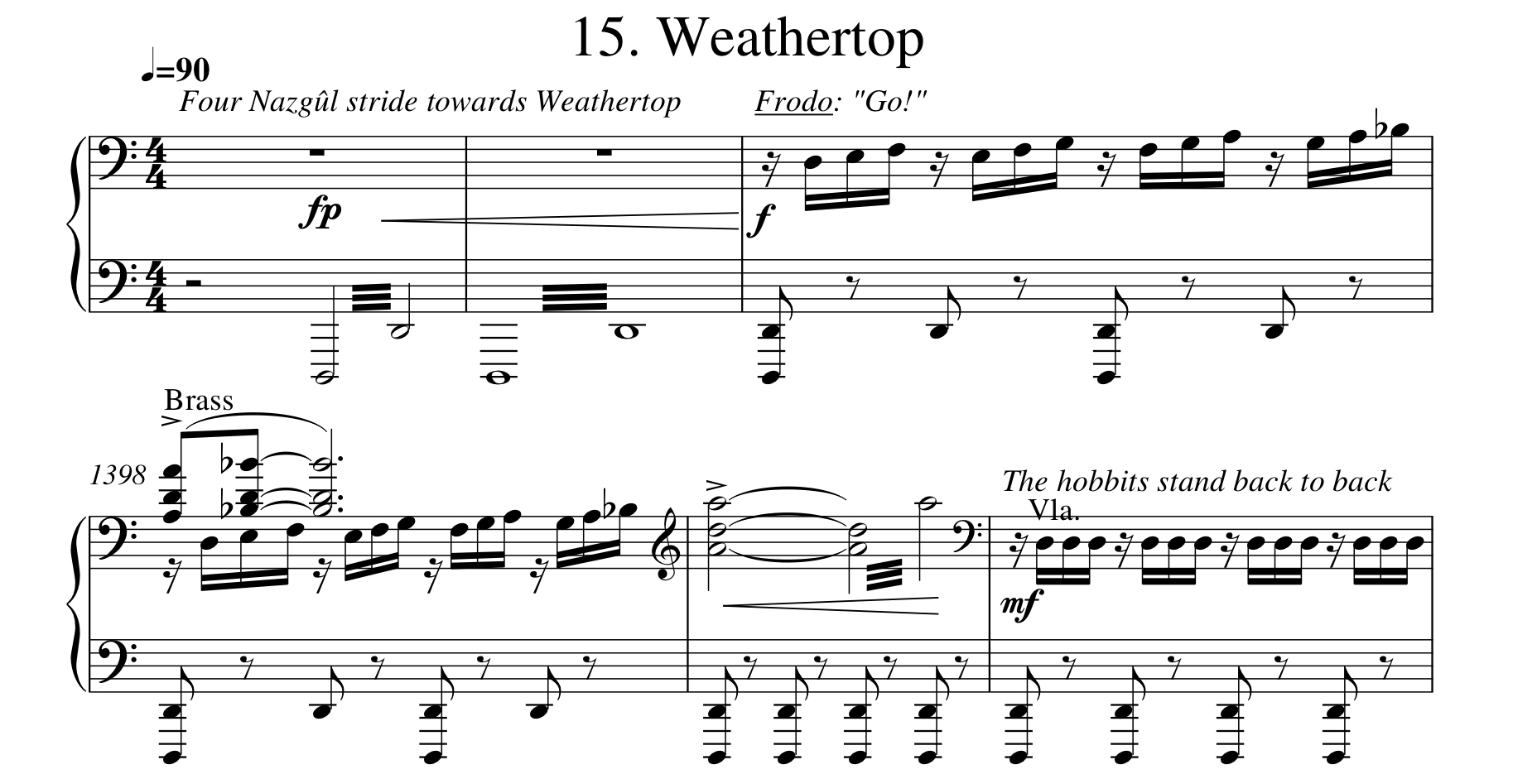
Howard Shore immediately starts with a fast-paced momentous introduction by using fast eighth and sixteenth notes in the top voices. This creates the forward momentum in the piece, as the lower bass voice
consists of only Ds. In fact, this happens from measure 1397 to 1401. These eighth and sixteenth notes create the sense of urgency and immediately establishes the threat imposed by the Nazgûl. I find this to be quite remarkable;
Howard Shore managed to use eighth and sixteenth notes masterfully to establish a tone even though the bass does not have any vertical movement.
This pattern appears again starting at measure 1402, except that the roles are swapped: now the eighth notes and the vertical movement occur in the base, whereas the stagnant voices occur in the higher voices. We will analyze both the horizontal
and vertical movement of the bass in the next section, but the eighth notes are notably responsible for propeling the piece forward.
Repeating Motifs: Descending Thirds
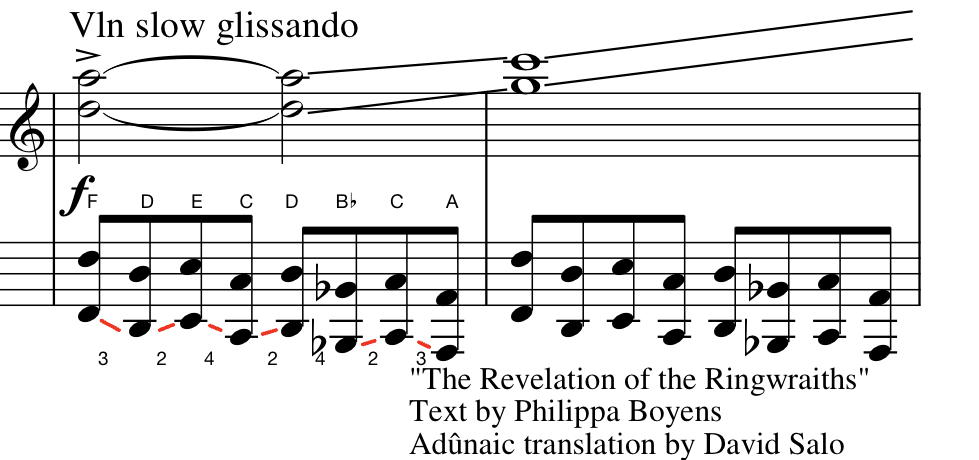
Howard Shore skillfully used repetition to further establish the foreboding mood. The first notable motif starts at measure 1402, where the bass line are the eighth notes
F — D — E — C — D — B♭ — C — A,
and this repeats for four measures. This repeating bass line is not accompanied by much in the other voices, but this horizontal movement is sufficient to establish an apprehensive and uneasy mood.
In particular, the bass line consists of descending thirds that not only creates dissonance and tension but also drives the piece forward. Analyzing the intervals of these notes in terms of semitones,
these eighth notes have the jumps
3 — 2 — 4 — 2 — 4 — 2 — 3.
In particular, the pattern of alternating between moving up two semitones (major seconds) and moving down four semitones (major thirds) is what gives the descending thirds their name. From this pattern,
we can conclude that the B♭ follows the D simply because the B♭ is a major third down from D. Descending lines, such as the descending thirds, are extremely effective at creating an atmosphre
of dread and inevitability, and the experience becomes more harrowing for the viewer the further the line descends. Furthermore, the mood is supported by a slow glissando that further augments the foreboding
atmosphere.
Repeating Motifs: Ostinato
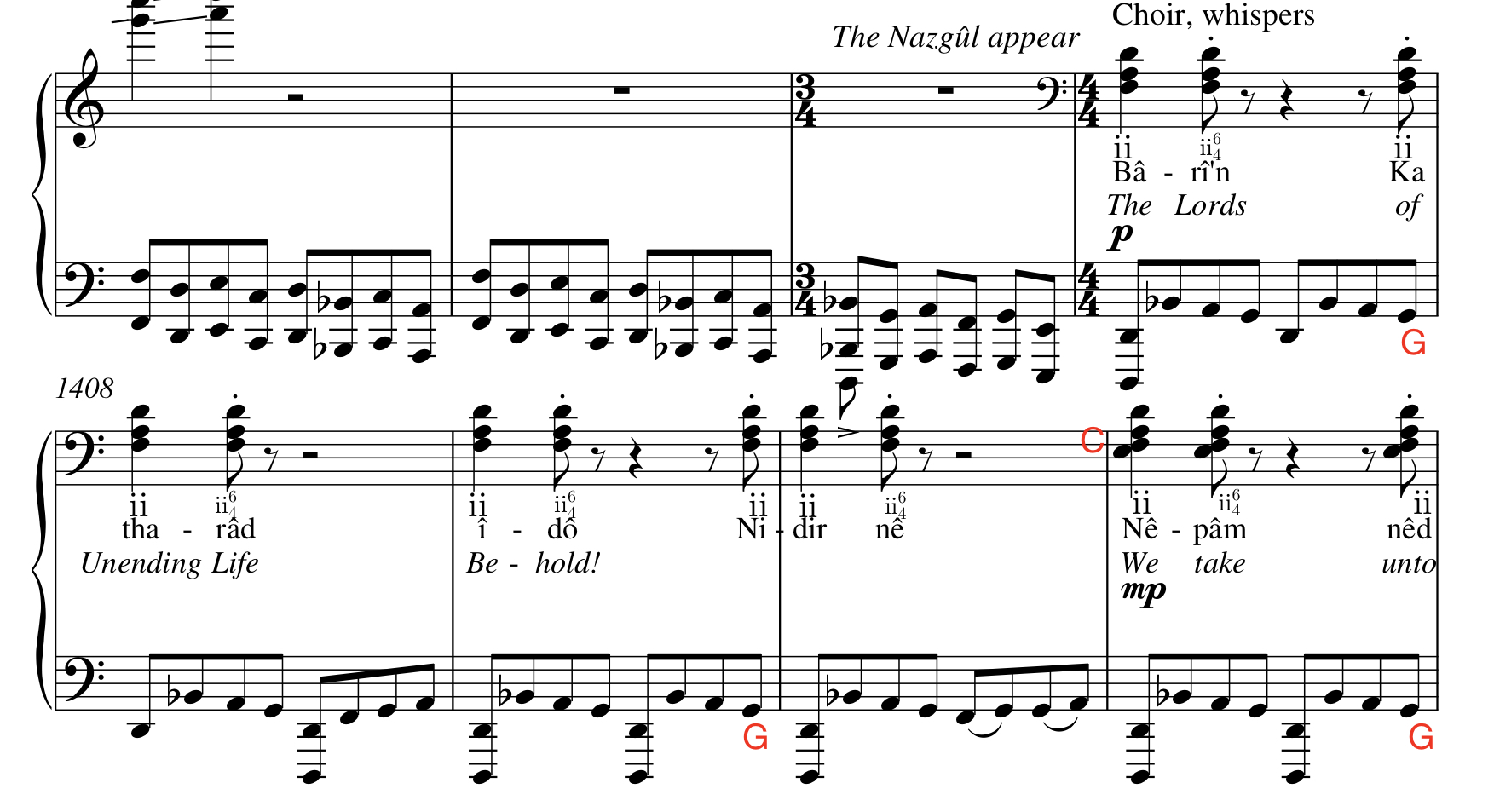
The repeating motifs are consistent parts of the piece moving forward. The bass line actually changes when the choir enters at measure 1407 and consists of mainly
D — B♭ — A — G — D — B♭ — A — G
and
D — B♭ — A — G — D — F — G — A.
The bass line is still in eighth notes, maintaining the momentum of the piece. This pattern in the bass is known as an ostinato. In fact, the other voices in the choir
do not have much contrapuntal movement; for measures 1407–1410, the other voices sing D, A, and F. In the key of C, these combination of notes form
\(\mathrm{ii}\) chords or \(\mathrm{ii}^6_4\) chords.
The repetitive and fast nature of the ostinato not only provide stability in the piece but also further solidifies the key theme of dread and anxiety caused by the arrival
of the Nazgûl. Similar to the descending thirds motif, this ostinato also descends, creating a harrowing feeling and a tense atmosophere. This is further compounded
by the choir. While the choir is singing the same three notes of D, A, and F, the Elvish lyrics augment the mystical and terrifying presence of the Nazgûl and allows
the viewer to not only understand how evil and twisted the Nazgûl are but also how little the Hobbits are compared to the Nazgûl.
Texture via Dissonance
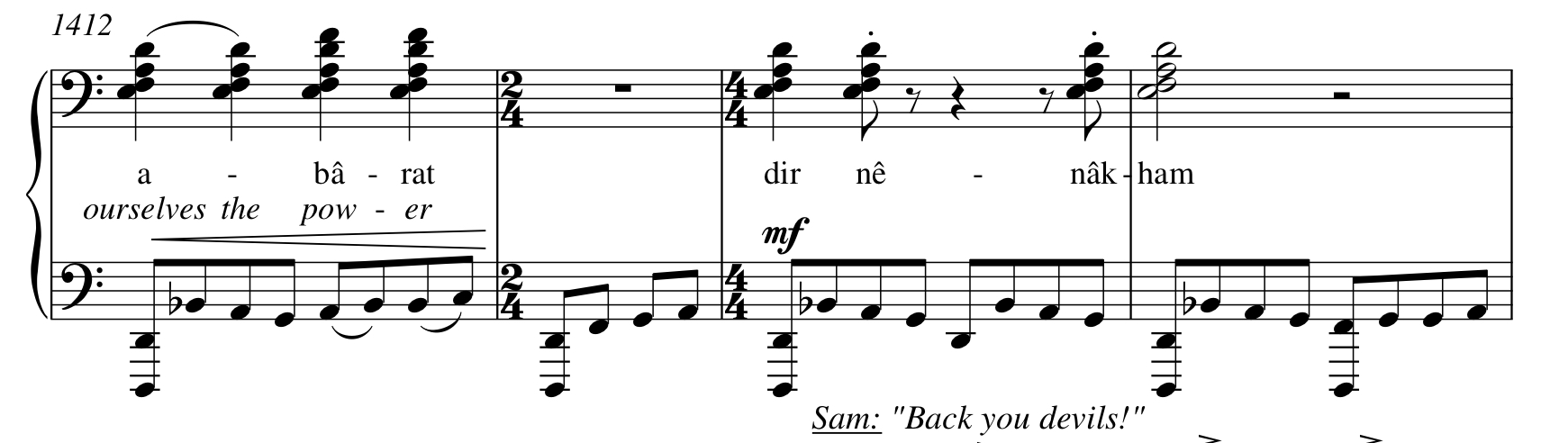
We can analyze the \(\mathrm{ii}\) chords more closely and identify notes that do not belong in those chords. For example, the last note of measure 1407 comprise G, F, A, and D.
As mentioned previously, the D, A, and F form the \(\mathrm{ii}\) chord, but the G does not belong in the chord. This adds dissonance to the piece.
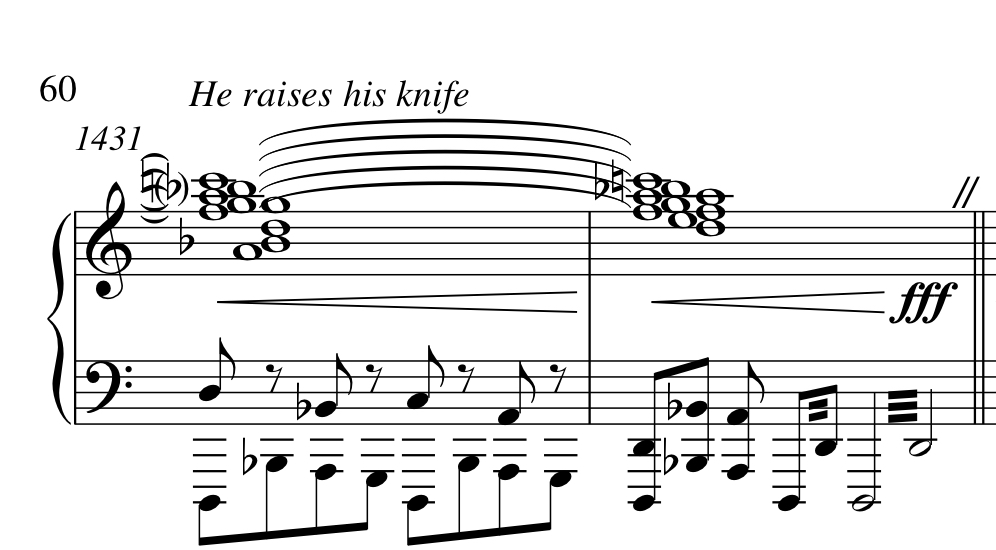
This is Howard Shore’s main method of adding texture to the music. This appears again in measure 1411, where the D, A, and F are joined by a dissonant G. In measure 1412, the D, A,
F, and G are joined by an E. Howard Shore continued adding texture until the piece is at its most climactic (when the Nazgûl raises his knife) in measures 1431 and 1432, where
there are so many dissonant notes.
Conclusion
Overall, “Weathertop” is a perfect introduction to the Nazĝl, their foreboding nature, and the threat they pose to Frodo and his friends. Howard Shore accomplishes this
using repetition: By using descending thirds and an ostinato that descends as well, Howard Shore created a threatening and uneasiness atmosphere. These emotions are further heightened by the
fast rhythm of the bass; the use of eighth and sixteenth notes creates forward momentum in the piece and a feeling of urgency. Finally, Howard Shore adds texture to the piece by adding dissonant
notes. I think this is a perfect representation of the Nazĝl: As they get closer, the theme becomes more dissonant, and it hits its climax when the Witch-King raises his knife to stab Frodo.
Despite the piece not having much counterpoint (the only main chords are \(\mathrm{ii}\) and \(\mathrm{ii}^6_4\), “Weathertop” achieves its goal of generating uneasyness and some foreboding atmosphere.
Last updated: October 15, 2025
 In particular, the pattern of alternating between moving up two semitones (major seconds) and moving down four semitones (major thirds) is what gives the descending thirds their name. From this pattern,
we can conclude that the B♭ follows the D simply because the B♭ is a major third down from D. Descending lines, such as the descending thirds, are extremely effective at creating an atmosphre
of dread and inevitability, and the experience becomes more harrowing for the viewer the further the line descends. Furthermore, the mood is supported by a slow glissando that further augments the foreboding
atmosphere.
In particular, the pattern of alternating between moving up two semitones (major seconds) and moving down four semitones (major thirds) is what gives the descending thirds their name. From this pattern,
we can conclude that the B♭ follows the D simply because the B♭ is a major third down from D. Descending lines, such as the descending thirds, are extremely effective at creating an atmosphre
of dread and inevitability, and the experience becomes more harrowing for the viewer the further the line descends. Furthermore, the mood is supported by a slow glissando that further augments the foreboding
atmosphere.
 The repetitive and fast nature of the ostinato not only provide stability in the piece but also further solidifies the key theme of dread and anxiety caused by the arrival
of the Nazgûl. Similar to the descending thirds motif, this ostinato also descends, creating a harrowing feeling and a tense atmosophere. This is further compounded
by the choir. While the choir is singing the same three notes of D, A, and F, the Elvish lyrics augment the mystical and terrifying presence of the Nazgûl and allows
the viewer to not only understand how evil and twisted the Nazgûl are but also how little the Hobbits are compared to the Nazgûl.
The repetitive and fast nature of the ostinato not only provide stability in the piece but also further solidifies the key theme of dread and anxiety caused by the arrival
of the Nazgûl. Similar to the descending thirds motif, this ostinato also descends, creating a harrowing feeling and a tense atmosophere. This is further compounded
by the choir. While the choir is singing the same three notes of D, A, and F, the Elvish lyrics augment the mystical and terrifying presence of the Nazgûl and allows
the viewer to not only understand how evil and twisted the Nazgûl are but also how little the Hobbits are compared to the Nazgûl.
 This is Howard Shore’s main method of adding texture to the music. This appears again in measure 1411, where the D, A, and F are joined by a dissonant G. In measure 1412, the D, A,
F, and G are joined by an E. Howard Shore continued adding texture until the piece is at its most climactic (when the Nazgûl raises his knife) in measures 1431 and 1432, where
there are so many dissonant notes.
This is Howard Shore’s main method of adding texture to the music. This appears again in measure 1411, where the D, A, and F are joined by a dissonant G. In measure 1412, the D, A,
F, and G are joined by an E. Howard Shore continued adding texture until the piece is at its most climactic (when the Nazgûl raises his knife) in measures 1431 and 1432, where
there are so many dissonant notes.