


Let's start with a familiar case: congruence mod  on the
ring
Z of integers. Just to be specific, let's use
on the
ring
Z of integers. Just to be specific, let's use
 . This congruence is an equivalence relation that is
compatible with the ring operations, in the following sense:
. This congruence is an equivalence relation that is
compatible with the ring operations, in the following sense:
 |
 |
 |
||
 |
|
 |
||
 |
 |
|
 |
|
|
|
|
|
|
|
|
|
|
 |
|
 |
|
|
|
|
|
|
 |
|
 |
and of course
 .
.
The same definition works for algebraic systems in general:
0.1 Definition. A congruence relation on an algebra
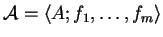 is an equivalence relation
that is compatible with the operations, in the sense
that for each basis operation
is an equivalence relation
that is compatible with the operations, in the sense
that for each basis operation  , if is
  -ary we have
 , ...,
 .
.
Terminology. Often we name a congruence relation  , say, and
write either
, say, and
write either
 or
or
 . Also, we may
say ``congruence'' instead of ``congruence relation''. Just as for
equivalence relations in general, we can speak of the blocks of a
congruence relation (or ``classes'', but that usage is somewhat old).
For
. Also, we may
say ``congruence'' instead of ``congruence relation''. Just as for
equivalence relations in general, we can speak of the blocks of a
congruence relation (or ``classes'', but that usage is somewhat old).
For  , the block of is often called
  .
.