


1.1 Definition. The width of a partially ordered set  is
the cardinality of the largest antichain. (For example, a chain
has width 1.)
is
the cardinality of the largest antichain. (For example, a chain
has width 1.)
Observation. If is the union of  chains, then
has width at most .
chains, then
has width at most .
1.2 Theorem (R. P. Dilworth) Let be a finite partially ordered
set of width . Then is a union of chains.
This is a kind of minimax theorem, in that it shows that the maximum
size of an antichain in is the minimum number of chains whose union
is . There are a number of combinatorial consequences. Here is one:
Let  be a binary relation between finite sets
 and
and  , i.e.,
 . A matching
of into is a one-to-one function
. A matching
of into is a one-to-one function
 such that
for all
such that
for all  ,
,
 .
.
1.3 Corollary (P. Hall's matching theorem) Given , a necessary
and sufficient condition for the existence of a matching of into
is that for each
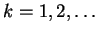 ,
,
(*) any  elements of are related to at least elements
of , in the sense that each of these elements of is
related to at least one of the elements of .
elements of are related to at least elements
of , in the sense that each of these elements of is
related to at least one of the elements of .
(In the proof, the disjoint union of and is made into
a partially ordered set by declaring  when
when  .)
.)
1.4 Definition
Let
 be subsets of a finite set.
A system of distinct representatives (SDR) for the
be subsets of a finite set.
A system of distinct representatives (SDR) for the  is a set of distinct elements
 with
with
 .
.
An obvious necessary condition for the existence of an SDR is
(*) For each
 , the union of any of the has at least elements.
1.5 Corollary (P. Hall's theorem on distinct representatives) The condition (*) is a necessary and sufficient condition for the existence of an SDR.
Recall that subsets
of a set
 form a partition of if the are pairwise
disjoint and have union . The are called the
blocks of the partition.
form a partition of if the are pairwise
disjoint and have union . The are called the
blocks of the partition.
We say that a partition is an equipartition if all its blocks have the same cardinality.
1.6 Corollary (Equipartition theorem) Two
equipartions of a finite set , each with the same number of
blocks, have a system of common representatives (SCR)--in other
words, one set of elements that constitutes a system of distinct
representatives for both of the two equipartitions.